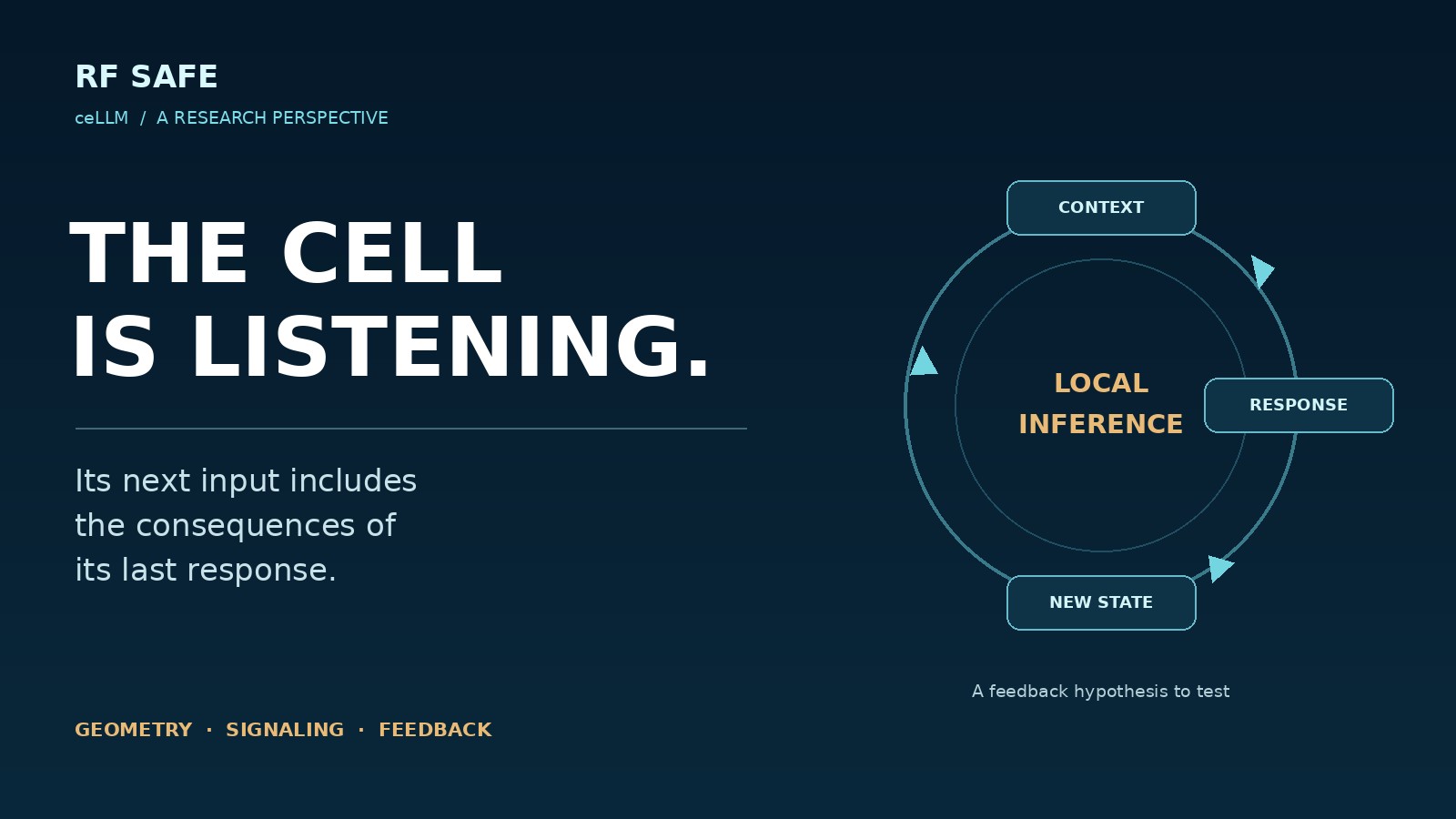
The cell’s next input includes its last response
A cell responds to the world through the physical machinery it already has. Receptors bind. Membranes maintain voltage. Calcium rises and falls. Mitochondria adjust metabolism. Proteins change activity. Chromatin helps determine which genes can respond.
Then something consequential happens: the response changes the conditions under which the next response will occur.
The cell’s next input includes the consequences of its last response.
That feedback is the center of RF Safe’s ceLLM framework. It raises a question for electromagnetic-exposure research: could a particular exposure, in a susceptible biological setting, change internal signaling enough that adaptation alters how the cell handles the next challenge?
Most perturbations might be corrected. Some might improve resilience. Others might combine with existing stress, consume reserve, or leave a persistent change. The scientific task is to distinguish those outcomes and identify the conditions that produce them.
This article connects established experiments with that proposed research program. The components of cellular feedback are experimentally grounded. The complete pathway from ordinary wireless exposure to persistent loss of signaling fidelity and accelerated aging has not been established.
ceLLM: inherited architecture, local inference, living context
ceLLM—RF Safe’s Cellular Latent Learning Model—uses computation as a way to organize a biological question: how does a cell turn its present circumstances and retained history into its next action?
Here, cellular intelligence means context-sensitive regulation that supports a biological task: finding a nutrient, repairing a wound, maintaining identity, or coordinating development. It does not require consciousness, language, or deliberate thought.
| Computational role | Proposed biological counterpart | What the comparison helps explain |
|---|---|---|
| Inherited response architecture | DNA sequence and the machinery it helps produce | Evolution constrains what responses are possible. |
| Retained settings and history | Chromatin organization, regulatory states, and other persistent cellular changes | The same current stimulus can encounter different prior conditions. |
| Runtime context | Membrane voltage, calcium, metabolites, redox state, mechanics, neighboring signals | The cell acts within a continuously changing local environment. |
| Processing system | The integrated cell, including organelles and molecular networks | Responses require an operating physical system. |
| Output and feedback | Changes in movement, secretion, growth, differentiation, repair, or connectivity | Each response can change future inputs. |
The body’s geometry is part of the runtime environment. The cell is the proposed local inference engine. DNA and chromatin contribute an evolved, physically implemented prior. These roles overlap: chromatin can both retain history and change during a response; bioelectric networks can also retain persistent state.
“Evolutionary training” is an analogy to selection across generations, not a claim that natural selection uses an AI training algorithm. Similarly, mitochondria are locally responsive subsystems embedded within cells; calling every organelle an independent LLM would obscure their dependence on shared cellular machinery.
Geometry becomes concrete inside the cell
Geometry matters wherever position and connection change an interaction. A regulatory sequence can affect a gene differently depending on chromatin contacts. An organelle’s proximity to another can change the local chemical signal it encounters. A protein’s shape affects binding and reaction pathways.
At the molecular scale, amino-acid side chains, cofactors, and their charge distributions contribute to those interactions. In a ceLLM model, a “weight” would represent a measurable influence—such as a change in binding probability or reaction rate—rather than being assumed to equal one resonant frequency.
Lupiáñez and colleagues supplied a particularly clear example: disrupting chromatin-domain boundaries rewired enhancer–gene interactions and produced abnormal developmental expression and limb phenotypes. The organization of the genome was causally relevant to its output. [1]
Mechanical connections also reach the nucleus. Tajik and colleagues applied forces at cell-surface adhesions and measured chromatin stretching and transcriptional changes through a pathway involving actomyosin, the LINC complex at the nuclear envelope, and nuclear structural connections. This gives the architecture-to-output connection an experimentally accessible route. [2]
Microtubules, actin, organelle positioning, and nuclear connections belong in the broader framework. Their roles must be identified individually. The Tajik experiment specifically supports an actomyosin-mediated route; it does not demonstrate a universal tubulin-to-DNA inference channel.
The flute analogy is useful here. Changing an opening changes the response of the instrument to comparable airflow. In a cell, molecular arrangement can change sensitivity, access, and coupling. But the living instrument also remodels itself in response to what it experiences.
Engineered DNA strand-displacement circuits have implemented neural-network computation. That demonstrates a molecular substrate performing a designed calculation; it does not show that native chromosomal DNA operates as an LLM. The experiment supplies a useful physical precedent, while the biological implementation remains the question. [3]
Proteins can be compared loosely to applications because adding, removing, or activating one changes available operations. In biology, however, the “application” is physical machinery: it changes reactions, binding, transport, and feedback rather than running as detachable software.
A cell brings its history to the neighborhood
A cell’s immediate environment is crucial, but it is not its entire identity. Local conditions include signals arriving from elsewhere in the body, and the cell brings its developmental history to those signals.
Chang and colleagues found that human fibroblasts from different anatomical sites retained distinctive expression patterns in culture, including positional features associated with HOX genes. This supports a maintained cellular history that persists beyond the original neighborhood. [4]
That is a firmer basis for the finger-versus-toe intuition: position is maintained through developmental programs, retained regulatory states, and continuing tissue interactions. The cell does not need to consult a map outside itself, and instantaneous local input is not sufficient to explain every response.
Mechanical history can persist as well. In experiments with human mesenchymal stem cells, the duration of exposure to a stiff substrate influenced later regulatory activity and differentiation after the environment softened. The result establishes memory of a particular mechanical history within the observation period—not a general proof of permanent damage or aging. [5]
Shared genes therefore do not imply identical runtime states. Even genetically similar cells can encounter different histories, signals, and constraints.
The feedback loop: correction, compensation, or persistence
Consider a candidate disturbance that actually reaches a relevant biological target. It changes a signal. The cell responds. That response changes metabolism, redox state, or regulatory activity. Those changes alter the environment in which subsequent signals are processed.
An important part of this loop has been measured directly. Booth and colleagues observed localized hydrogen-peroxide signaling at the interface between the endoplasmic reticulum and mitochondria. Calcium elevations induced local redox changes that fed back onto calcium signaling. Here, location and timing were features of a coupled physical system. [6]
Zorov and colleagues demonstrated another form of amplification: experimentally induced oxidative stress could trigger additional mitochondrial ROS production in cardiac cells. The experiment also revealed thresholds, antioxidant dependence, and reversible responses. Neither study used ordinary wireless exposure as its initiating stimulus. [7]
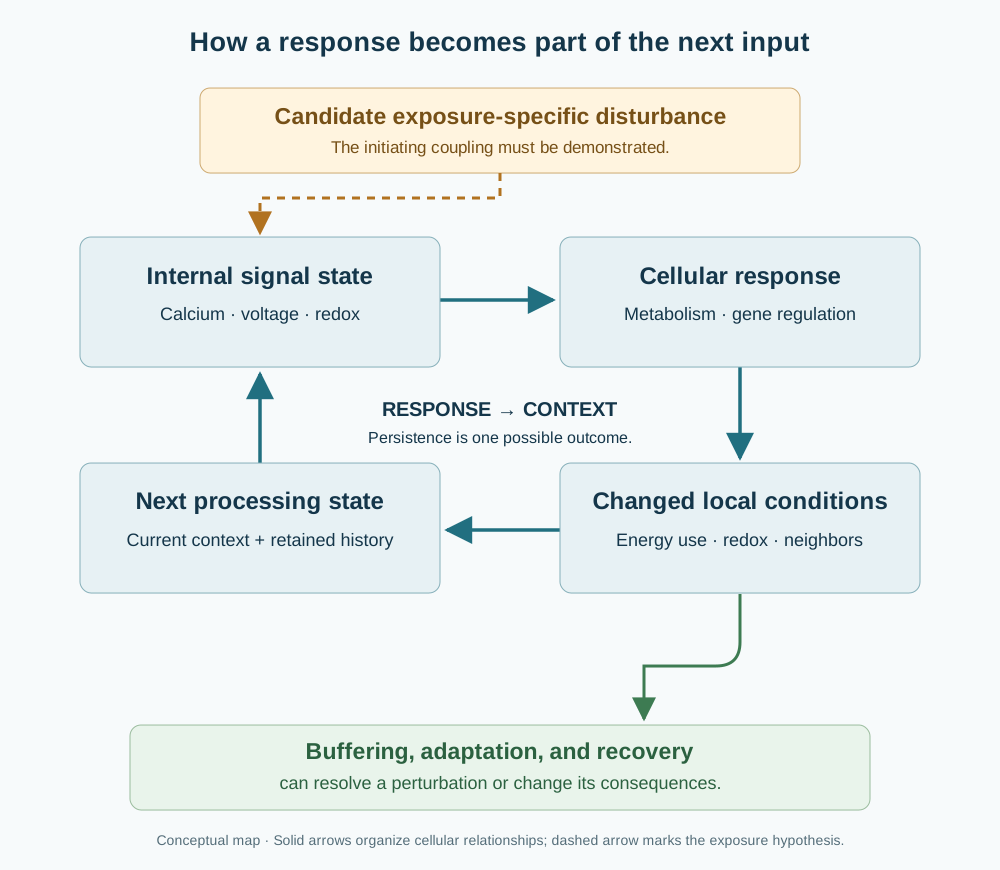
There are at least three possible outcomes. Correction returns the system toward its earlier response pattern. Compensation preserves a measured function while other settings or costs change. Persistence leaves a changed response after the original disturbance ends. Persistence itself can be beneficial, neutral, or harmful.
The ceLLM concern is a particular subset: a misleading internal state produces an inappropriate response, and the response helps maintain the misleading state. A system can execute its response rules consistently while operating on a distorted estimate of its circumstances.
This is also where a compound stressor could matter. A perturbation that has little detectable effect in one state might matter in another. That possibility calls for interaction experiments; it does not establish that every additional stressor makes every exposure harmful.
EXPLORE FEEDBACK · MATHEMATICAL ILLUSTRATION
When does a disturbance fade?
A short input ends at step 12. Change how strongly the system reinforces its current deviation and how strongly it returns toward baseline.
With feedbackSame recovery, no feedback
This is not an RF exposure, cell, or aging simulation. It illustrates how feedback and recovery can change the fate of a temporary perturbation. Values are invented and do not estimate biological harm.
Model and assumptions
xt+1 = (1 − r)xt + gxt/(1 + xt) + ut
Initial state x = 0. The input u = 0.18 for the first 12 updates and zero thereafter. The parameters g and r are the selected feedback and recovery strengths. After input ends, g > r permits a positive stable state x = g/r − 1; g ≤ r gives eventual decay toward zero. The reference curve sets g = 0 with the same r. Neither curve assigns a biological meaning or health outcome to its state.
Calcium carries a pattern, not just an amount
The calcium connection is experimental rather than merely metaphorical. Dolmetsch and colleagues showed that intracellular calcium-signal amplitude and duration can differentially activate transcription factors. Subsequent calcium-clamp experiments demonstrated that oscillation patterns influence the efficiency and specificity of gene expression. [8] [9]
Two signals with comparable averages can differ in peaks, spacing, duration, and spatial localization. A downstream molecular system may distinguish those features. A useful experiment therefore measures the pattern that reaches the relevant compartment, along with the resulting function.
This motivates the shoreline analogy:
You cannot understand what waves do to a shoreline by measuring only the volume of the ocean.
The analogy illustrates why averaging can hide structure. It does not establish that an RF waveform reaches a cell’s calcium decoder, or that any measured timing shift is damaging. Those are separate experimental questions.
The proposed failure is also broader than two rhythms drifting out of synchrony. A timing change could alter which downstream pathway is activated, how long it remains active, or what internal condition the cell effectively represents. To call that an error, researchers need a defined task and evidence of a less appropriate response.
The AI connection: changing an intermediate state
An AI model’s weights do not specify one answer independently of input, activation state, and the computation performed on them. They help implement a transformation whose output depends on the running system.
Anthropic’s 2026 research on verbalizable representations offers a useful analogy. Its J-space identifies a particular subset of model representations; interventions on intermediate activations can redirect downstream behavior while the weights remain fixed. [10]
For ceLLM, the comparison is that an existing response architecture can produce a different output when an intermediate state changes. Candidate biological variables include membrane voltage, calcium dynamics, redox state, and regulatory activity.
J-space is not the entire AI runtime, and no corresponding cellular J-space has been experimentally identified. Naming the actual biological variables keeps the analogy useful. The further ceLLM proposal is that repeated alterations of those variables might eventually change persistent regulatory settings as well.
A temporary change in context could become a lasting change in responsiveness. Whether an exposure does this, and whether function improves or deteriorates, must be measured.
What field experiments establish—and what remains to connect
Several experiments make a receiver-centered research program reasonable. They involve different exposures and biological systems, so their results cannot be combined as though they were one completed causal pathway.
A calcium-rhythm-dependent gene switch. Kim and colleagues reported an engineered electromagnetic-field-responsive system in which a CRISPR screen identified CYB5B as an essential mediator and likely sensor. Activation depended on rhythmic calcium signaling rather than a generic calcium increase. This is a specific molecular foothold. Controlling gene expression is different from editing the DNA sequence, and responsiveness in the engineered system does not establish the response to a household wireless exposure. [11]
A genotype-associated human physiological response. In a randomized, sham-controlled study of 34 volunteers, Sousouri and colleagues reported a genotype-by-exposure interaction involving the noncoding CACNA1C variant rs7304986. For T/C carriers, a first-NREM-episode analysis found spindle center frequency rising from about 13.62 to 13.82 Hz after 3.6 GHz exposure; the T/T group did not show the same response. This is roughly a 1.5% difference in that measured rhythm, not a measurement of whole-body aging speed. The study did not establish the variant’s molecular mechanism or adverse health consequences. [12]
Magnetic control of radical-pair chemistry. Burd and colleagues used combined static and radiofrequency magnetic fields near electron-spin resonance to alter reactions in an engineered fluorescent-protein/flavin system in living worms. The experiment demonstrates field-sensitive chemistry under defined conditions. It does not establish an equivalent mechanism in native human cells under ambient telecommunications exposure. [13]
Spin chemistry requires particular reaction lifetimes, molecular couplings, field strengths, and frequencies. A separate theoretical analysis found negligible effects for the low-amplitude telecommunications-frequency conditions it modeled. Such calculations help define what a proposed coupling mechanism must overcome; an observed spin effect elsewhere cannot substitute for that calculation. [14]
S4–Mito–Spin: a map of hypotheses to test
RF Safe’s S4–Mito–Spin framework organizes possible entry points and downstream amplification. It should be read as a research map with distinct evidentiary levels.
| Branch | Established or demonstrated foothold | Question the framework proposes |
|---|---|---|
| S4 / membrane sensing | Positive charges in sodium-channel S4 segments contribute to voltage sensing. | Can a specified external field measurably alter gating under the conditions being claimed? |
| Mito / calcium–redox coupling | Organelles participate in localized calcium–redox feedback; CYB5B mediates an engineered field response. | Does an exposure engage a native pathway strongly enough to change function or future responsiveness? |
| Spin / reaction probabilities | Certain radical-pair reactions respond to magnetic conditions. | Are suitable molecules, lifetimes, and coupling strengths present in the target tissue and exposure? |
| Persistence / recovery | Cells can retain regulatory and environmental history. | Does the effect resolve, remain compensatory, or persist with impaired function? |
The S4 entry route for weak external fields is a proposed mechanism, not a conclusion supplied by the fact that a channel senses its normal transmembrane voltage. The step from an external field to the channel must be established quantitatively. [15]
A low-frequency magnetic field is also physically different from a microwave carrier with a slowly varying envelope. Similar numerical repetition rates do not make them equivalent exposures. The biological system would need a demonstrated coupling or nonlinear detection process that makes the relevant signal feature available to it.
Claims about terahertz resonances require the same discipline: identify the mode, its conditions, and its functional coupling. This framework does not depend on an unverified match between mitochondrial resonances and fixed “elemental frequencies” in DNA. Molecular organization is already consequential without that additional claim.
ROS: a signal, a stress response, and sometimes damage
Reactive oxygen species are involved in signaling as well as oxidative injury. Their location, duration, magnitude, and consequences matter. In a particular worm model, increased mitochondrial superoxide signaling contributed to increased lifespan. That result illustrates why a rise in a ROS marker cannot by itself diagnose accelerated aging. [16]
RF-associated oxidative responses have nevertheless been reported in original experiments. Durdik and colleagues found increased ROS after one hour of UMTS exposure in some human cord-blood cell populations at approximately 0.040 W/kg under their test conditions. They did not demonstrate sustained DNA damage or increased apoptosis; the fusion-gene analyses did not establish an exposure effect. The absence of the ROS increase after three hours of exposure did not establish recovery: the authors also considered changes in oxygen/incubation conditions. [17]
A compound-stressor experiment is especially instructive. Luukkonen and colleagues exposed cultured neuroblastoma cells to 872 MHz RF at 5 W/kg, with or without the prooxidant menadione. Continuous-wave RF enhanced chemically induced ROS and DNA damage; the GSM-like pulsed condition did not produce those effects. That supports investigating combinations while showing why “pulsed” cannot automatically mean “more disruptive.” [18]
Literature tallies reporting a large proportion of positive oxidative studies can help locate experiments. They do not establish how often real-world exposure causes harm. “Effect” is not necessarily “increase,” the studies do not all use pulsed signals, and a paper count does not automatically account for experimental quality or exposure differences.
For ceLLM, the important sequence is exposure → measured internal change → altered response to a defined input → functional consequence → persistence or recovery. Each arrow needs its own evidence.
Surviving the next minute can change the next decade
A cell can redirect resources toward an immediate challenge. Under sustained stress, a response that helps maintain short-term function may coexist with longer-term costs. That makes the “next five minutes versus the next fifty years” analogy a useful research question, provided it is not treated as an inevitable fate.
RF Safe uses low-fidelity biology for a proposed reduction in the reliability of biological responses: poorer discrimination between inputs, inappropriate activation, slower recovery, or reduced performance under a later challenge. Its meta-disease state is a proposed susceptibility concept, not a clinical diagnosis or validated biomarker.
To make these terms scientific, each experiment must specify what fidelity means. For a wound model, it might be reliable closure and restored tissue organization. For an immune-cell assay, it might be appropriate discrimination between defined stimuli. A change in a biomarker without a demonstrated loss of function would not meet that definition by itself.
Aging research from David Sinclair’s group makes persistent regulatory state relevant, but does not complete the RF argument. Lu and colleagues reported restoration of aspects of visual function and youthful molecular features after partial reprogramming in mice. Yang and colleagues used an engineered DNA-break-and-repair model to investigate epigenetic disruption and aging-like changes. These studies support investigation of regulatory plasticity; they do not show that ordinary wireless exposure drives the same process. [19] [20]
Reprogramming changes gene-regulatory programs. Describing it as removing buildup from a geometric machine is a metaphor, not a demonstrated molecular explanation.
Likewise, “entropy” should not become a synonym for everything undesirable. Damage, stress, regulatory variability, and epigenetic change are different measurements. Living cells use energy and export heat and waste while maintaining organization. This article uses “loss of fidelity” operationally; it does not calculate thermodynamic entropy.
There is no single clock governing every tissue
Epigenetic clocks estimate aspects of biological state from molecular measurements. They are not one master oscillator making every organ or limb age at exactly the same rate. Horvath’s multi-tissue methylation work showed both broad age-related structure and differences among tissues and biological contexts. [21]
Comparable limbs share developmental programs and much of their systemic environment, yet they can experience different injuries, loading, circulation, and exposures. Similar appearance does not establish identical biological aging.
Sun exposure is a reminder that local histories matter, but its mechanisms should not be transferred wholesale to radio waves. Radiofrequency photons do not directly ionize DNA in the way ionizing radiation can. Indirect damage, if it occurs under particular conditions, would require a causal route through heating, chemistry, signaling, or another demonstrated interaction. The proposed timing pathway is one candidate to test.
A changed rhythm is not automatically a faster biological clock. Demonstrating accelerated aging would require longitudinal functional and molecular outcomes, not an arithmetic extrapolation from a 0.20 Hz sleep-spindle shift.
From Becker and Levin to geometric inference
Robert Becker’s work helped establish an experimental tradition connecting endogenous electrical phenomena with regeneration. Later experiments gave that connection increasingly specific biological interventions. [22]
In Michael Levin’s research program, manipulating membrane voltage altered regeneration and developmental outcomes. Adams, Masi, and Levin demonstrated a role for proton-pump-dependent voltage changes in Xenopus tail regeneration. These findings show that bioelectric conditions can participate causally in tissue organization. [23]
Planarian studies extend the question to retained state. Emmons-Bell and colleagues produced temporary, species-like head-shape changes after gap-junction perturbation. Durant and colleagues subsequently demonstrated persistent changes in regenerative outcomes after a transient bioelectric intervention. These are different experiments and different persistence results; neither directly measured a chromatin-based geometric blueprint. [24] [25]
The ceLLM connection is that collective form can depend on local response rules, communication, and retained state. Shared inherited machinery and real communication between cells operate together. A population of similar local controllers can produce organized behavior, but cells also exchange chemical, electrical, and mechanical signals.
Regenerative “attractors” can be useful mathematical descriptions of stable outcomes. Their existence does not by itself show that a particular anatomical form is the global thermodynamic minimum, or that environmental RF pushes it out of its basin. Those are additional hypotheses.
What higher-dimensional geometry contributes
The amplituhedron provides a striking example of geometry revealing structure hidden by a cumbersome calculation. Arkani-Hamed and Trnka formulated scattering amplitudes in a particular theory—planar N=4 supersymmetric Yang–Mills theory—using positive geometry. Feynman diagrams are calculation terms, not thousands of alternative anatomical instructions or literal particle paths. [26]
Carolina Figueiredo, a recipient of the 2026 Vera Rubin New Frontiers Prize, has helped extend geometric and combinatorial approaches through work on hidden zeros and surface kinematics, revealing relations among additional scattering theories. That is a substantial advance with a defined mathematical scope. [27] [28] [29]
For ceLLM, the productive connection is methodological: a suitable geometry might make response constraints and relationships easier to predict. It does not follow that cells calculate scattering amplitudes or that these papers establish a universal geometry of intelligence.
| Meaning of geometry | What it describes here |
|---|---|
| Physical geometry | Molecular shape, chromatin contacts, membrane organization, and tissue structure in space and time. |
| State-space geometry | Relationships among many variables such as voltage, calcium, gene activity, and metabolism. Its dimensions count variables, not extra spatial directions. |
| Scattering geometry | A mathematical construction encoding relations in specified quantum-field-theory calculations. |
Stephen Wolfram’s ruliad offers a separate proposed computational account of underlying reality. It can motivate questions about how rules generate structures, but it is not an experimentally established derivation of cellular inference. Its computational elements are not measured particles smaller than the Planck length. [30]
“Geometric inference all the way down” is therefore a research ambition: investigate how physical organization constrains response probabilities across scales. Calling atomic interactions inference becomes informative only if the term leads to measurable variables and better predictions than an ordinary reaction-network description. A high-dimensional representation can describe a fully physical process occurring within spacetime.
What the FCC, HHS, and researchers should measure
The regulatory question deserves precision. FCC rules use metrics including specific absorption rate and power density, with spatial and temporal averaging. SAR measures the rate of energy absorption per mass; it is not a temperature reading. The rules distinguish whole-body and localized exposure, and “peak spatial average” refers to location, not the peak of an individual RF pulse. [31] [32]
The FCC has considered submissions about nonthermal effects. Its decision to retain limits does not mean it declared such interactions physically impossible. In 2021, the D.C. Circuit found its explanation inadequate on important issues involving evidence of effects unrelated to cancer and remanded the decision. The court did not settle the biological debate or validate the ceLLM mechanism. [33] [34]
The measurement gap proposed here is specific: compliance metrics do not directly report whether a cell is accurately processing a biologically meaningful signal. That observation alone does not prove compliant exposures impair signaling. It identifies what additional evidence would be needed to assess that possibility.
For the FCC, the question is whether the evidentiary basis for exposure rules adequately addresses relevant waveforms, exposure histories, and susceptible populations. For HHS agencies, including FDA and NIH/NIEHS, the opportunity is coordinated mechanistic research and independent replication. For academic laboratories, it is linking a measured interaction to a defined functional outcome in the same system.
This biology is not unknown to academia: the evidence throughout this article comes from researchers studying signaling, mechanics, chromatin, and regeneration. The proposed advance is to connect those measurements more directly to exposure science and safety assessment.
The public deserves a clear distinction between a measured interaction, a proposed mechanism, demonstrated adversity, and an estimate of real-world risk. A stronger research program can make those distinctions more informative.
An experiment that could change the conversation
The decisive study would follow a causal chain instead of collecting isolated biomarkers.
- Define the task and exposure. Choose a native cell or tissue system with a reproducible input–response relationship. Measure the actual waveform at the sample, absorbed power, temperature, and field distribution. Predefine functional outcomes.
- Test the compound-stressor hypothesis. Use randomized, blinded sham/RF and unstressed/background-stressor conditions. Test the statistical interaction, rather than assuming two separate effects demonstrate synergy. Compare waveform features at controlled doses.
- Track the intermediate state. Measure calcium patterns, local redox changes, and relevant receptor or channel activity alongside performance. Account for measurement artifacts and normal variability.
- Interrupt and rescue the proposed pathway. Test whether blocking the candidate mediator removes the effect and whether restoring the relevant signaling pattern restores function. Include controls for the intervention’s own effects.
- Remove exposure and challenge the cells again. After a defined washout, give exposed and control cells the same ordinary input. Test response curves, chromatin state, and recovery. Track survival and lineage to distinguish retained regulatory change from selection of different cells.
The framework gains support if a specified exposure causes a reproducible signaling change that mediates impaired function, persists where predicted, and responds to the proposed rescue. It loses support where adequate measurements show no relevant perturbation, no functional consequence, complete recovery within the defined window, or a failed mechanistic prediction.
These experiments can also reveal beneficial adaptation. That outcome would improve the model by establishing where its proposed failure pathway does not apply.
Protecting the response, not merely describing the exposure
The central ceLLM proposal is that molecular architecture, present signals, and retained cellular history jointly shape response probabilities. Each response then helps construct the conditions for the next one.
That picture connects geometry to function without requiring intelligence to live outside spacetime. It connects stress to future responsiveness without declaring every adaptation damage. And it gives electromagnetic biology a demanding question: under which conditions does an exposure change the fidelity of that continuing process?
The signal is part of the biological question. The receiver and its history are part of the answer.
The next advance should make that relationship measurable.
Sources and study boundaries
Original experiments, original theoretical work, and regulatory documents. Source types are labeled so a mathematical proposal is not confused with a biological experiment. The text describes what each source does and does not establish.
- ExperimentLupiáñez DG, et al. Disruptions of topological chromatin domains cause pathogenic rewiring of gene-enhancer interactions. Cell. 2015;161:1012–1025. Read source
- ExperimentTajik A, et al. Transcription upregulation via force-induced direct stretching of chromatin. Nature Materials. 2016;15:1287–1296. doi:10.1038/nmat4729. Read source
- Engineered molecular computationQian L, Winfree E, Bruck J. Neural network computation with DNA strand displacement cascades. Nature. 2011;475:368–372. Read source
- ExperimentChang HY, et al. Diversity, topographic differentiation, and positional memory in human fibroblasts. PNAS. 2002;99:12877–12882. doi:10.1073/pnas.162488599. Read source
- ExperimentYang C, Tibbitt MW, Basta L, Anseth KS. Mechanical memory and dosing influence stem cell fate. Nature Materials. 2014;13:645–652. doi:10.1038/nmat3889. Read source
- ExperimentBooth DM, et al. Redox Nanodomains Are Induced by and Control Calcium Signaling at the ER-Mitochondrial Interface. Molecular Cell. 2016;63:240–248. doi:10.1016/j.molcel.2016.05.040. Read source
- ExperimentZorov DB, et al. Reactive oxygen species (ROS)-induced ROS release: a new phenomenon accompanying induction of the mitochondrial permeability transition in cardiac myocytes. Journal of Experimental Medicine. 2000;192:1001–1014. Read source
- ExperimentDolmetsch RE, et al. Differential activation of transcription factors induced by Ca2+ response amplitude and duration. Nature. 1997;386:855–858. doi:10.1038/386855a0. Read source
- ExperimentDolmetsch RE, Xu K, Lewis RS. Calcium oscillations increase the efficiency and specificity of gene expression. Nature. 1998;392:933–936. doi:10.1038/31960. Read source
- AI researchGurnee W, et al. Verbalizable Representations Form a Global Workspace in Language Models. Transformer Circuits / Anthropic. July 6, 2026. Read source
- Engineered experimental systemKim J, et al. Electromagnetic field-inducible in vivo gene switch for remote spatiotemporal control of gene expression. Cell. 2026;189:3465–3480.e23. doi:10.1016/j.cell.2026.03.029. Read source · Published correction (2026)
- Human experimentSousouri G, et al. 5G radio-frequency-electromagnetic-field effects on the human sleep electroencephalogram: A randomized controlled study in CACNA1C genotyped volunteers. NeuroImage. 2025;317:121340. Read source · Author-uploaded published full text
- Engineered experimental systemBurd SC, et al. Magnetic resonance control of spin-correlated radical pair dynamics in vivo. Nature. 2026;651:940–945. doi:10.1038/s41586-026-10282-4. Read source
- Theoretical modelTalbi, Zadeh-Haghighi, Simon. The radical pair mechanism cannot explain telecommunication frequency effects on reactive oxygen species. Frontiers in Quantum Science and Technology. 2025. doi:10.3389/frqst.2025.1544473. Read source
- ExperimentStühmer W, et al. Structural parts involved in activation and inactivation of the sodium channel. Nature. 1989;339:597–603. doi:10.1038/339597a0. Read source
- ExperimentYang W, Hekimi S. A Mitochondrial Superoxide Signal Triggers Increased Longevity in Caenorhabditis elegans. PLOS Biology. 2010;8:e1000556. doi:10.1371/journal.pbio.1000556. Read source
- RF cell experimentDurdik M, et al. Microwaves from mobile phone induce reactive oxygen species but not DNA damage, preleukemic fusion genes and apoptosis in hematopoietic stem/progenitor cells. Scientific Reports. 2019;9:16182. doi:10.1038/s41598-019-52389-x. Read source
- RF cell experimentLuukkonen J, et al. Enhancement of chemically induced reactive oxygen species production and DNA damage in human SH-SY5Y neuroblastoma cells by 872 MHz radiofrequency radiation. Mutation Research. 2009. doi:10.1016/j.mrfmmm.2008.12.005. Read source
- Mouse experimentLu Y, et al. Reprogramming to recover youthful epigenetic information and restore vision. Nature. 2020;588:124–129. doi:10.1038/s41586-020-2975-4. Read source
- Engineered mouse modelYang JH, et al. Loss of epigenetic information as a cause of mammalian aging. Cell. 2023;186:305–326.e27. doi:10.1016/j.cell.2022.12.027. Read source · Published correction (2024)
- Biomarker developmentHorvath S. DNA methylation age of human tissues and cell types. Genome Biology. 2013;14:R115. doi:10.1186/gb-2013-14-10-r115. Read source · Correction to cancer-data analysis (2015)
- Foundational experimentBecker RO. The bioelectric factors in amphibian-limb regeneration. Journal of Bone and Joint Surgery American Volume. 1961;43-A:643–656. Read source
- ExperimentAdams DS, Masi A, Levin M. H+ pump-dependent changes in membrane voltage are an early mechanism necessary and sufficient to induce Xenopus tail regeneration. Development. 2007;134:1323–1335. Read source
- Regeneration experimentEmmons-Bell M, et al. Gap Junctional Blockade Stochastically Induces Different Species-Specific Head Anatomies in Genetically Wild-Type Girardia dorotocephala Flatworms. International Journal of Molecular Sciences. 2015. doi:10.3390/ijms161126065. Read source
- Regeneration experimentDurant F, et al. Long-Term, Stochastic Editing of Regenerative Anatomy via Targeting Endogenous Bioelectric Gradients. Biophysical Journal. 2017. doi:10.1016/j.bpj.2017.04.011. Read source
- Mathematical physicsArkani-Hamed N, Trnka J. The Amplituhedron. Journal of High Energy Physics. 2014;10:030. arXiv:1312.2007. Read source
- Official award recordBreakthrough Prize Foundation. Carolina Figueiredo: 2026 Vera Rubin New Frontiers Prize. Official award record. Read source
- Mathematical physicsArkani-Hamed N, Cao Q, Dong J, Figueiredo C, He S. Hidden zeros for particle/string amplitudes and the unity of colored scalars, pions and gluons. Journal of High Energy Physics. 2024;10:231. arXiv:2312.16282. Read source
- Mathematical physicsArkani-Hamed N, Cao Q, Dong J, Figueiredo C, He S. Surface Kinematics and “The” Yang-Mills Integrand. Physical Review Letters. 2025;134:171601. arXiv:2408.11891. Read source
- Proposed computational ontologyWolfram S. The Concept of the Ruliad. Stephen Wolfram Writings. November 10, 2021. Read source
- Regulatory text47 CFR §1.1310. Radiofrequency radiation exposure limits. Electronic Code of Federal Regulations text via Cornell Legal Information Institute. Read source
- Regulatory text47 CFR §2.1093. Radiofrequency radiation exposure evaluation: portable devices. Electronic Code of Federal Regulations text via Cornell Legal Information Institute. Read source
- Agency decisionFederal Communications Commission. Human Exposure to Radiofrequency Electromagnetic Fields (FCC 19-126). Federal Register. April 1, 2020;85:18131 onward. Read source
- Court opinionEnvironmental Health Trust et al. v. Federal Communications Commission and United States. U.S. Court of Appeals for the D.C. Circuit, No. 20-1025. August 13, 2021. Read source