When the organization does the computing
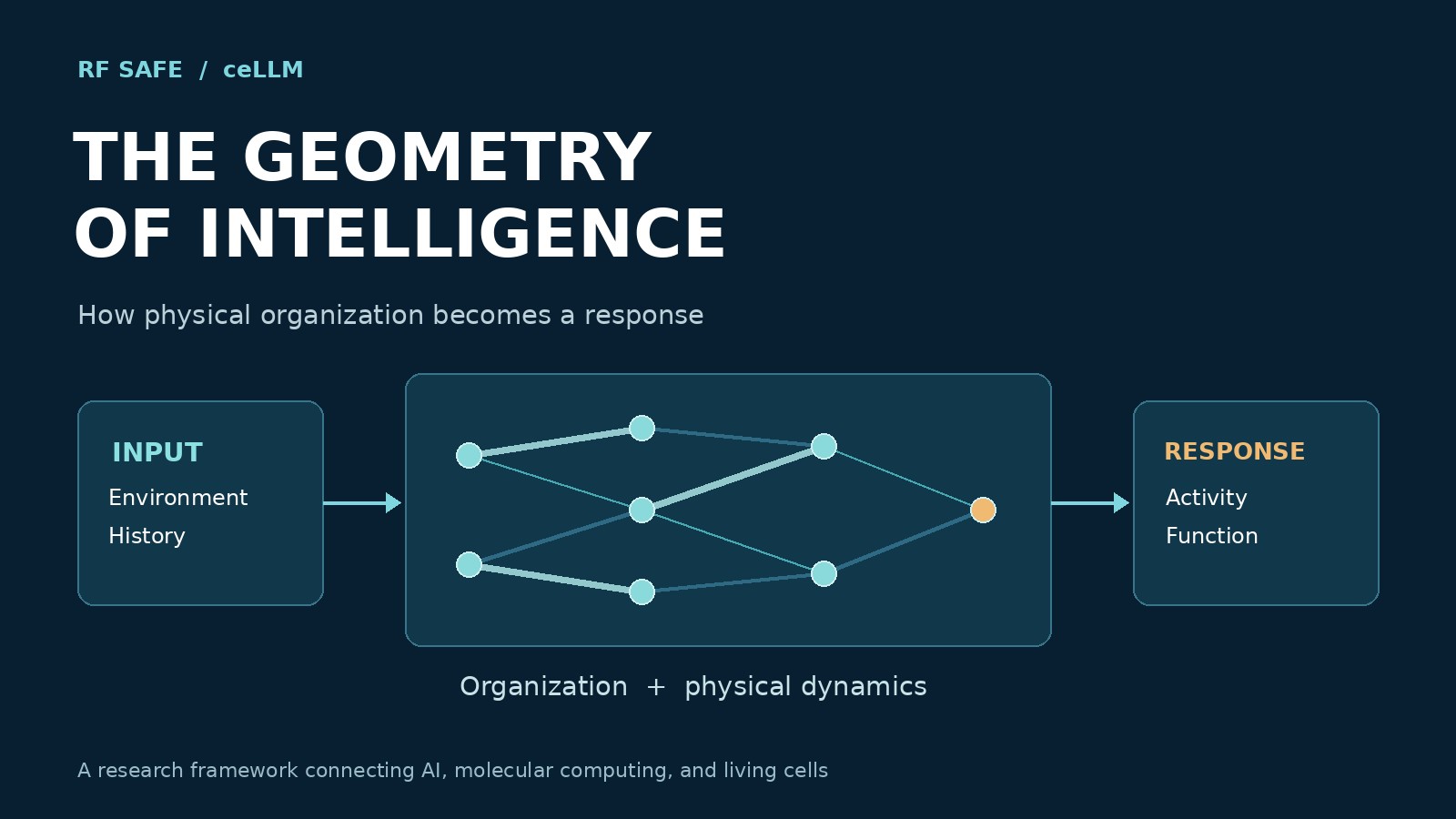
Print an artificial neural network's weights and biases on paper and you have a record of learned relationships. Supply those relationships to a working implementation, present an input, and the system produces a response. The difference is physical: stored information becomes an operating transformation when matter, energy, timing, and an appropriate architecture bring the relationships into action.
That distinction is the starting point of ceLLM. What if a cell's molecular organization plays a comparable role? What if the arrangement of its regulatory elements, molecular interactions, electrical conditions, and feedback loops helps embody the transformations the cell can perform?
In this view, geometry can be part of the mechanism. It includes which components can interact, the strengths of their interactions, the thresholds that make them respond, and the states the system can reach. The actual response unfolds through the physics of those relationships.
The proposed connection is this: physical organization gives a system a repertoire of possible responses; input and internal state determine which response is realized; activity can then reshape the organization itself.
This article develops that idea as RF Safe's ceLLM research framework. It brings together experimental molecular computing, developmental bioelectricity, epigenetic reprogramming, genetic variation, and geometric approaches to physics. Their connection is a proposed synthesis with specific tests. The studies described below establish different parts of the argument; they do not yet demonstrate one universal geometry of intelligence.
Is the geometry already the answer?
A useful answer is that an organized system can contain the disposition to produce an answer. A trained model specifies a transformation across many inputs. The particular output also depends on the prompt, ongoing activity, and sometimes stochastic sampling. A cellular response likewise depends on its starting condition and the input's history.
Hopfield's associative-memory model supplies an early concrete example: collective network dynamics can recover stored patterns. Interactions help define stable states, while an incomplete input sets the starting condition for retrieval. This is one way an answer can be implicit in a system's organization and realized through its subsequent activity. [1]
There need not be one unique visible shape for each answer. In neural networks, rearranging hidden-unit labels while preserving their relationships can leave all outputs unchanged. Different parameter arrangements can therefore implement the same function. What matters scientifically is the causal organization that survives such changes of description. Research on neural-network permutation symmetries makes this distinction concrete. [2]
ceLLM should consequently ask which measurable relationships constrain behavior, rather than assign a special geometric silhouette to every thought or cellular decision. Does changing a molecular contact change the response? Does changing an interaction strength shift a threshold? Does restoring a relationship restore function? Those are questions about implemented organization.
“Higher dimensional” can be understood in the same grounded way. Three coordinates might locate a molecule, but thousands of variables may be needed to describe a cell: concentrations, membrane potentials, protein states, chromatin contacts, metabolic conditions, and mechanical forces. Their combined state occupies a high-dimensional mathematical space. Its changing trajectory describes events occurring within the physical cell.
An engineer can discover a useful configuration in the space of possibilities while creating the physical system that implements it. Evolution likewise selects among physically possible organizations, while development constructs and maintains living examples. Whether mathematical possibilities exist independently is a philosophical question. The causal roles of their physical implementations can be investigated experimentally.
Matter already computes in the laboratory
The transition from numerical models to physical processing has already been demonstrated. Wright and colleagues trained optical, mechanical, and electrical systems to perform neural-network transformations. Their work uses the systems' physical input–output behavior within a trainable architecture. Ordinary digital hardware is one way to implement these relationships; useful transformations can also be carried by other organized physical processes. [3]
DNA chemistry provides a closer example. In 2011, Lulu Qian, Erik Winfree, and Jehoshua Bruck implemented a small associative-memory network through DNA strand-displacement reactions. Parameters were trained computationally and embodied in a chemical network that could recover a stored pattern from incomplete information. This was an engineered molecular implementation of a neural-network operation. [4]
An especially relevant result appeared on September 16, 2026. Tristan Stérin and colleagues reported a thermodynamically favoured molecular computer: a scaffolded DNA system whose programmed interactions make the computational output a favored molecular configuration. The experiments implemented ten programs, including arithmetic. Here, the organization of binding relationships and the accessible energy landscape participate directly in producing the answer. [5]
These experiments establish that molecular organization can implement computation. Native genomic DNA operates in a different biological setting, and demonstrating the same kind of operation there requires its own evidence. The distinction also matters thermodynamically: the scaffolded computer approaches an engineered equilibrium, whereas living cells continuously consume energy to maintain activity away from equilibrium.
The research opportunity is now concrete: identify which computations, if any, are implemented by particular native molecular organizations, and measure what those organizations allow a cell to do.
The cell, the prior, and the living runtime
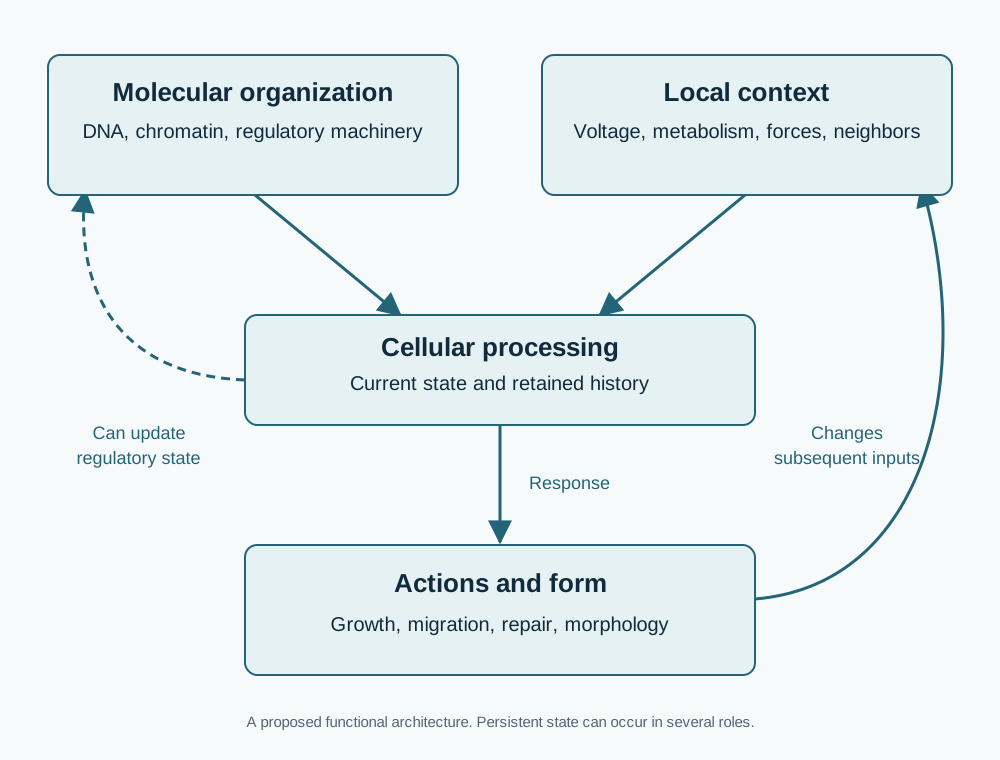
ceLLM proposes the cell as a local inference system operating within a body that continually changes its context. DNA and chromatin contribute durable constraints shaped by evolution, development, and experience. Physiological activity makes those constraints operational. Tissue architecture helps determine what the cell encounters next.
| Biological component | Proposed computational role | Physical quantities to investigate |
|---|---|---|
| DNA and chromatin | Evolved and adjustable response constraints | Sequence, accessibility, molecular recognition, regulatory contacts |
| Cellular machinery and retained state | Local processing and memory | Reaction rates, thresholds, feedback, persistent molecular states |
| Bioelectricity and metabolism | Context, coordination, and energetic support | Membrane voltage, ion activity, ATP supply, redox conditions |
| Cytoskeleton and extracellular matrix | Mechanical organization and context | Forces, contacts, stiffness, transport pathways |
| Neighboring cells and body morphology | A shared runtime that becomes subsequent input | Communication, tissue boundaries, local signals, geometry |
These roles overlap. Mitochondria supply signals as well as energy. Chromatin changes in response to context. Bioelectric circuits can retain history. Calling the body a runtime does not require it to be memoryless, and assigning DNA a durable role does not make DNA the exclusive store of everything an organism has learned.
“Trained physical prior” is useful language for an inherited and adjustable predisposition to respond. Evolution does not use the same training procedure as a language model. DNA also operates through RNA, proteins, membranes, water, ions, and the rest of the cell. The relevant computational candidate is this organized living system.
There is already causal evidence that regulatory arrangement matters. Lupiáñez and colleagues linked disruption of chromatin-domain boundaries to altered gene–enhancer contacts and developmental abnormalities. Yet organization is not a single master switch: Rao and colleagues eliminated cohesin-dependent loop domains while observing comparatively limited immediate transcriptional changes. Which relationships matter depends on the process, cell state, and timescale. [6] [7]
For ceLLM, a useful statement is: a cell's effective “weights” may be distributed across contact probabilities, binding affinities, molecule numbers, conductances, and reaction kinetics. Mapping those quantities to computational roles is a hypothesis to test. It need not assume that every atom is a neuron or that DNA forms a literal crystalline neural network.
From scattering geometry to biological response
Nima Arkani-Hamed and Jaroslav Trnka's amplituhedron provides a striking precedent for reorganizing a complicated physical calculation through geometry. In its original setting—planar, maximally supersymmetric Yang–Mills theory—an associated canonical mathematical form encodes quantities conventionally assembled through Feynman diagrams. It is not simply the ordinary volume of a solid. [8]
Carolina Figueiredo, recipient of the 2026 Vera Rubin New Frontiers Prize, has helped extend the search for geometric and combinatorial structure in scattering theory. Work with Arkani-Hamed, Qu Cao, Jin Dong, and Song He identified hidden zeros and relationships among selected scalar, pion, and gluon amplitudes. Their surface-kinematics work also addresses planar nonsupersymmetric Yang–Mills loop integrands. [9] [10] [11]
The lesson for ceLLM is methodological and ambitious: a large catalogue of separate events may share an organizing structure that makes their relationships easier to calculate. In biology, could measured molecular organization predict a whole family of responses, including responses that have not yet been observed?
That question is stronger than saying both physics and cells have shapes. It asks for a mapping from organization to outcomes. Scattering geometry supplies a precedent for successful mathematical compression; it does not supply an established mechanism for cellular intelligence.
Stephen Wolfram approaches the foundations from computation. His ruliad is a proposed limiting structure of possible computations and their relationships. Work by Arsiwalla and Gorard investigates how rewriting systems can acquire topological organization through homotopy types. These are candidate accounts of how relational transformations could underlie physical description. [12] [13]
ceLLM connects to this question at the level of physically implemented transformations. A cell is a local interface: it encounters some conditions, retains some state, and changes its surroundings. “Observer” can describe that limited access in an information-processing model; it should not equate a cell with the reference-frame observer of relativity. Nor does the proposed connection require treating Wolfram's model, amplitude geometry, and cellular regulation as already identical theories.
Becker and Levin: the context changes the outcome
The biological lineage reaches back beyond fifty years. Alan Turing demonstrated how local reaction and diffusion could generate organized spatial patterns. Robert O. Becker's early salamander work brought electrical measurements and electrical interventions into the study of regeneration. Their shared significance is that organized form can depend on distributed physical interactions. [14] [15]
Michael Levin and collaborators supplied more specific experimental interventions. In a Xenopus tail model, proton-pump activity was required for regeneration, and an introduced pump could restore regeneration under tested conditions. Manipulating membrane voltage during Xenopus development could also alter eye formation, including ectopic eye tissue. Electrical conditions can therefore affect how developmental machinery is deployed. [16] [17]
Neural cellular automata offer a clear computational comparison: a trained local update rule, repeatedly applied using neighboring states, can grow and repair a target pattern. The rule supplies capabilities; context supplies the next input; repeated activity produces morphology. That model does not identify the mechanism of a living cell, but it makes the proposed ceLLM architecture understandable. [18]
Developmental bioelectricity fits this architecture as a source of context and coordination with the capacity to preserve state. A cell changes its activity, the tissue changes, and the altered tissue becomes the next condition the cell must process. Morphology is both an outcome and a participant in the next round of activity.
Sinclair: recovering function through selective retuning
David Sinclair's work adds a different experimental window: can a cell recover aspects of function by changing its regulatory state?
In 2020, Yuancheng Lu and colleagues expressed Oct4, Sox2, and Klf4—OSK—in mouse retinal ganglion cells. They reported more youthful DNA-methylation and gene-expression patterns, axon regeneration after injury, and improved visual function in glaucoma and aging models. The benefits depended on the DNA-demethylation machinery TET1 and TET2. Crucially, a separate intervention that broadly demethylated DNA did not reproduce the same regenerative benefit. [19]
The tree-ring analogy helps describe a biological record of history, but it has a limit. Epigenetic marks are active regulatory features, and aging involves patterned gains and losses. They are not a uniform coating to scrape off. For ceLLM, the more useful interpretation is selective retuning of an existing regulatory system.
Yang and colleagues' 2023 work also examined chromatin organization using contact maps and looping measurements, alongside epigenetic and functional changes in their experimental models. Spatial regulatory relationships are therefore measurable parts of this discussion. [20]
The ceLLM hypothesis is that some recoverable losses of function reflect altered access to a response repertoire, altered coupling within it, or changed operating conditions. Reprogramming might restore some of those relationships. Establishing that explanation requires showing which measured organizational changes cause the recovered function. The experiments do not establish a universal youthful geometric template or prove that every form of aging is reversible.
“Entropy” also needs a defined meaning. Thermodynamic entropy, uncertainty in a signal, and variability in methylation patterns are different quantities. Living cells spend energy maintaining organization; aging cannot be reduced to a single unmeasured accumulation of geometric disorder. ceLLM becomes more useful when it specifies what drifts, how that drift changes performance, and what an intervention restores.
CACNA1C: a genetic difference in a physiological response
CACNA1C is a concrete connection between genetic organization and electrical physiology. The gene encodes the pore-forming α1C subunit of the CaV1.2 calcium channel. The variant rs7304986 lies in a noncoding intron of this protein-coding gene. A noncoding variant does not directly specify an amino-acid substitution; its functional significance must be established experimentally. Earlier sleep-genetics work identified rs7304986 among correlated variants in this region. [21]
In Sousouri and colleagues' 2025 double-blind, sham-controlled study, 34 volunteers received standardized 30-minute exposures before sleep. In T/C carriers, regional spindle-center frequency shifted from approximately 13.62 Hz under sham to 13.82 Hz after 3.6-GHz exposure, during the first NREM episode. Comparable topographic changes were not detected in T/T carriers or with 700-MHz exposure. A separate model across exposure conditions reported a genotype-by-exposure interaction (p = 0.04). [22]
This was a measurable change in a brain rhythm: the same exposure protocol produced different responses in groups distinguished by a single-letter genetic marker. [22]
The volunteers were genotyped, not made genetically identical except for an edited nucleotide. The result does not isolate that letter as causal or identify a change in channel shape, expression, or gating. A linked variant could contribute, and clinical harm was not established. [22]
A second CACNA1C variant sometimes discussed here, rs2302729, belongs to a separate observational study of subjective sleep quality and self-rated electromagnetic sensitivity. That association should not be merged with the controlled exposure experiment or presented as proof of an exposure mechanism. [23]
The ceLLM interpretation is a research proposition: a molecular difference may alter the transformation from context to response. To test that mechanism, compare otherwise matched cellular systems, identify a functional regulatory difference, measure channel physiology and downstream activity, and determine whether correcting the difference changes the response as predicted.
Timing can change a computation without changing its wiring
A network's connectivity is only part of its operation. Its gains, thresholds, delays, and available energy also matter. A cell can therefore change its response while retaining the same broad shape and the same set of connections.
Calcium experiments have shown that oscillation patterns can alter transcriptional responses. More recently, experiments in two immortalized human cell preparations found different transcriptional-reporter responses to spaced and massed chemical stimulation with matched total stimulus-on time. Those results establish sensitivity to biological timing in particular systems. They do not by themselves identify an electromagnetic cause. [24] [25]
EXPLORE THE IDEA · ILLUSTRATIVE MODEL
Same input. Different response settings.
Hold the input fixed, then change the coupling or threshold. The response curve changes because the implemented transformation changes.
Model: output = 1 / (1 + exp[−8 × coupling × (input − threshold)]). The reference uses coupling 1 and threshold 0.5. Values have no biological units. This demonstrates a response function; it is not a simulation of aging, a calcium channel, intelligence, or an RF effect.
RF Safe's proposed “low-fidelity biology” framework asks whether some disturbances reduce the reliability with which living systems distinguish and respond to relevant inputs. A changed average signal is not automatically reduced fidelity. The relevant test is performance: can the cell still discriminate inputs, coordinate an appropriate response, recover after disturbance, and maintain the specified function?
The RF question is whether a calibrated exposure changes those capacities through an identified physiological pathway. A pulsed radiofrequency carrier and its low-frequency envelope must be characterized as the actual waveform; an envelope is not automatically a separately emitted low-frequency electric field of the same magnitude. A biological timing hypothesis still needs a measured route by which the exposure reaches the relevant cellular process.
Existing null findings help constrain that route. For example, Platano and colleagues reported no significant acute effect of their tested 900-MHz continuous-wave and GSM-modulated exposures on currents through voltage-gated calcium channels in cultured rat cortical neurons. A ceLLM exposure mechanism must explain the conditions under which an effect should occur and those under which it should not. [26]
A common experimental language
The proposed bridge can be written compactly:
Here, G represents measured relationships and arrangement; θ represents interaction strengths, thresholds, and rates; x is the current cellular state; u is the environmental input; F describes state evolution; and R identifies a measured response. This is a model specification, not evidence that the proposed mapping has already been established.
It separates three experimentally different possibilities. An inherited variant may change the system's response constraints. An epigenetic intervention may reconfigure them. A change in physiological or environmental context may drive the same system along a different trajectory. These mechanisms can interact without being interchangeable.
| Research connection | What is already supported | What ceLLM must still demonstrate |
|---|---|---|
| Physical and synthetic DNA computing | Organized physical interactions can implement useful computations | Which comparable operations occur in native cellular machinery |
| Amplitude geometry | Geometric structures organize specified scattering calculations | A predictive mathematical mapping for biological responses |
| Developmental bioelectricity | Electrical interventions can redirect development or regeneration in tested models | Which molecular response constraints mediate each effect |
| Epigenetic reprogramming | Regulatory interventions can recover selected functions in experimental models | Which organizational changes cause the recovery |
| CACNA1C and sleep physiology | A controlled study reports a genotype-dependent exposure response | The causal variant, molecular mechanism, replication, and functional significance |
The decisive experiment should measure organization first and predict a response to an input withheld from model fitting. It should then change a specified relationship, predict the resulting change in behavior, and test whether restoring that relationship restores the response. A useful ceLLM model must improve prediction or simplify explanation relative to comparably flexible gene-regulatory and signaling models.
For aging research, this means testing whether recovered contacts, accessibility, or interaction kinetics explain recovered function beyond a change in an epigenetic clock. For genotype research, it means isolating the causal molecular difference. For RF research, it means separating timing from peak exposure, absorbed energy, temperature history, and measurement artifacts.
An RF timing study could compare periodic and temporally jittered pulse sequences while matching pulse height, width, count, and total energy over the same interval. It would measure early physiology, later responses to biological inputs, and functional outcomes. Blinded analysis, independent exposure replicates, appropriate thermal controls, and interventions on the proposed mediator would determine whether the suggested pathway survives scrutiny. A well-powered null result would narrow the mechanism rather than count as hidden evidence for it.
The connection ceLLM proposes
The unifying idea is an architecture of response: matter and energy realize relationships; those relationships constrain transformations; living systems use the transformations to regulate, adapt, and construct their surroundings. Intelligence, in this operational sense, concerns useful performance under changing conditions. It is a stronger claim than the existence of a complicated shape or a history-dependent material.
DNA and chromatin can contribute durable response constraints. Bioelectricity, metabolism, mechanical structure, and neighboring cells provide changing conditions and additional retained state. Cellular activity produces morphology. Morphology then changes the conditions for subsequent cellular activity.
That makes the body a continually reconstructed runtime, the cell a candidate local inference engine, and molecular organization a physical basis for what the system can do next. The same perspective makes aging, regeneration, genetic variation, and timing sensitivity comparable questions about how response capabilities are maintained, altered, and sometimes recovered.
The opportunity is to turn geometry into a predictive account of biological capability: measure the organization, predict the response, change the organization, and test the prediction again.
That is the research program ceLLM proposes. Its strength will come from connections that can be measured closely enough to make a difference to the next experiment.
Sources and further reading
Primary research and original theoretical proposals. Source descriptions distinguish experimental results from proposed foundations.
- Hopfield JJ. Neural networks and physical systems with emergent collective computational abilities. Proceedings of the National Academy of Sciences. 1982;79:2554–2558. Read source
- Ainsworth SK, Hayase J, Srinivasa S. Git Re-Basin: Merging Models modulo Permutation Symmetries. ICLR 2023; preprint 2022. Read source
- Wright LG, et al. Deep physical neural networks trained with backpropagation. Nature. 2022;601:549–555. Read source
- Qian L, Winfree E, Bruck J. Neural network computation with DNA strand displacement cascades. Nature. 2011;475:368–372. Read source
- Stérin T, Eshra A, Evans CG, Adio J, Woods D. A thermodynamically favoured molecular computer. Nature. 2026;657:646–652. Published September 16, 2026. Read source
- Lupiáñez DG, et al. Disruptions of topological chromatin domains cause pathogenic rewiring of gene-enhancer interactions. Cell. 2015;161:1012–1025. Read source
- Rao SSP, et al. Cohesin loss eliminates all loop domains. Cell. 2017;171:305–320.e24. Read source
- Arkani-Hamed N, Trnka J. The amplituhedron. Journal of High Energy Physics. 2014;10:030. Preprint first posted in 2013. Read source
- Breakthrough Prize Foundation. Carolina Figueiredo. 2026 Vera Rubin New Frontiers Prize. Official award record. Read source
- Arkani-Hamed N, Cao Q, Dong J, Figueiredo C, He S. Hidden zeros for particle/string amplitudes and the unity of colored scalars, pions and gluons. arXiv:2312.16282. 2023. Read source
- Arkani-Hamed N, Cao Q, Dong J, Figueiredo C, He S. Surface kinematics and "the" Yang-Mills integrand. Physical Review Letters. 2025;134:171601. Preprint first posted in 2024. Read source
- Wolfram S. The concept of the ruliad. Stephen Wolfram Writings. November 10, 2021. Author's foundational proposal. Read source
- Arsiwalla XD, Gorard J. Pregeometric spaces from Wolfram model rewriting systems as homotopy types. arXiv:2111.03460. 2021. Read source
- Turing AM. The chemical basis of morphogenesis. Philosophical Transactions of the Royal Society of London B. 1952;237:37–72. Read source
- Becker RO. The bioelectric factors in amphibian-limb regeneration. Journal of Bone and Joint Surgery American Volume. 1961;43-A:643–656. Read source
- Adams DS, Masi A, Levin M. H+ pump-dependent changes in membrane voltage are an early mechanism necessary and sufficient to induce Xenopus tail regeneration. Development. 2007;134:1323–1335. Read source
- Pai VP, Aw S, Shomrat T, Lemire JM, Levin M. Transmembrane voltage potential controls embryonic eye patterning in Xenopus laevis. Development. 2012;139:313–323. Read source
- Mordvintsev A, Randazzo E, Niklasson E, Levin M. Growing neural cellular automata. Distill. 2020. Read source
- Lu Y, et al. Reprogramming to recover youthful epigenetic information and restore vision. Nature. 2020;588:124–129. Read source
- Yang JH, et al. Loss of epigenetic information as a cause of mammalian aging. Cell. 2023;186:305–326.e27. Read source
- Byrne EM, et al. A genome-wide association study of sleep habits and insomnia. American Journal of Medical Genetics Part B: Neuropsychiatric Genetics. 2013;162B:439–451. Read source
- Sousouri G, et al. 5G radio-frequency-electromagnetic-field effects on the human sleep electroencephalogram: A randomized controlled study in CACNA1C genotyped volunteers. NeuroImage. 2025;317:121340. Read source · Author-uploaded published full text
- Eicher C, Marty B, Achermann P, Huber R, Landolt HP. Reduced subjective sleep quality in people rating themselves as electro-hypersensitive: An observational study. Sleep Medicine. 2024;113:165–171. Read source
- Dolmetsch RE, Xu K, Lewis RS. Calcium oscillations increase the efficiency and specificity of gene expression. Nature. 1998;392:933–936. Read source
- Kukushkin NV, Carney RE, Tabassum T, Carew TJ. The massed-spaced learning effect in non-neural human cells. Nature Communications. 2024;15:9635. Read source
- Platano D, et al. Acute exposure to low-level CW and GSM-modulated 900 MHz radiofrequency does not affect Ba2+ currents through voltage-gated calcium channels in rat cortical neurons. Bioelectromagnetics. 2007;28:599–607. Read source