Tell the federal health agencies what to study—and what to change.
The RFI is scheduled for Federal Register publication on September 21, 2026. The expected 30-day deadline is October 21; confirm the final date on the live docket before filing.
Two federal records · One public duty
HHS and the FCC are asking the public what the evidence means. RF Safe's position is direct: a thermal compliance number cannot answer a lifetime biological-timing question. This is the moment to put the full science—and a workable path to lower-exposure technology—into the federal record.

The RFI is scheduled for Federal Register publication on September 21, 2026. The expected 30-day deadline is October 21; confirm the final date on the live docket before filing.
Use ECFS, enter proceeding 13-84, and address children, long-term exposure, device testing, non-cancer effects, modulation, and environmental evidence.
Secretary Robert F. Kennedy Jr. has signed a sweeping federal Request for Information on electromagnetic fields, radiofrequency radiation, and wireless exposure. HHS is not asking the public to repeat the regulatory position. It is asking what the evidence shows, where the present system fails, what research is missing, and what the federal health agencies should do. RF Safe's answer is direct: the thermal-centered framework is scientifically incomplete, the current limits were not built to protect against lifetime cancer, reproductive, developmental, or bioelectrical effects, and the accumulated warning signals now require protective action.
For RF Safe, this is the policy opening we have spent more than three decades demanding.
On September 17, 2026, the Department of Health and Human Services placed a notice on public inspection titled Request for Information on Electromagnetic Fields, Radiofrequency Radiation, and Wireless Radiation Exposure. It is scheduled for publication in the Federal Register on September 21, 2026, as document 2026-19252. The notice is signed by HHS Secretary Robert F. Kennedy Jr.
The notice does not itself create a new exposure limit or enforcement action. Its importance is that it opens the federal evidence record from which those actions can follow. What enters that record—and what HHS does with it—can shape national research, public-health guidance, product-radiation policy, disease surveillance, school practices, consumer disclosure, and the scientific advice supplied to the FCC.
The immediate action: Submit one evidence-based comment to HHS Docket HHS-OASH-2026-0397. The public-inspection notice says comments are due 30 days after Federal Register publication. If publication occurs as scheduled on September 21, the expected deadline is October 21, 2026; verify the final date on the live docket before filing.
Open the HHS docket on Regulations.gov
Federal wireless policy has long been trapped inside an artificially narrow frame: prevent excessive short-term heating, express compliance mainly through power density or specific absorption rate, and assume that exposures below the resulting limits are adequately protective.
The new HHS notice does not accept that narrow frame as the only question worth asking. It explicitly requests evidence about:
That list matters. The federal government is now asking, in one notice, about many of the variables that an acute heating limit cannot resolve.
A signal can remain far below a thermal injury threshold while still possessing a carrier frequency, an amplitude envelope, a pulse-repetition pattern, a duty cycle, sharp transitions, polarization, phase relationships, spatial gradients, and a schedule of exposure and recovery. Biology responds to timing as well as energy. A safety system that averages away those variables cannot claim to have tested them.
HHS asked for public positions. This is ours.
Compliance with the current FCC limit is not proof of biological safety. The limit is organized around avoiding excessive heating and acute stimulation under prescribed test conditions. It is not a quantitative lifetime cancer standard. It is not a reproductive-risk standard. It is not a child-development standard. It is not a test of calcium-waveform fidelity, mitochondrial recovery, membrane-voltage regulation, gene-expression timing, or the cumulative consequences of exposure from conception through old age.
That mismatch is no longer a minor technical gap. The record now includes positive lifetime animal carcinogenicity findings, independent corroboration of a rare tumor type, WHO-commissioned reviews assigning high certainty to specific animal cancer endpoints, reproductive warning signals, human studies that cannot be dismissed through crude exposure categories, and experimentally demonstrated routes by which defined electromagnetic inputs can alter voltage-sensitive and calcium-coded biology.
The threshold for public-health action is not proof that RF is the sole cause of every tumor, fertility problem, or developmental disorder. Public health acts when credible evidence identifies preventable risk, vulnerable populations, inadequate standards, and feasible ways to reduce exposure. Those conditions are present now.
RF Safe's position is that the evidence has crossed the threshold for precaution, independent federal investigation, modernized exposure standards, truthful disclosure, and lower-RF infrastructure. Uncertainty about the exact size of the risk is not evidence that the risk is zero.
This is not anti-technology. It is pro-engineering. Fiber, Ethernet, power over Ethernet, meaningful radio-off controls, and Li-Fi compatibility can preserve connectivity while reducing unnecessary RF exposure. The public should not be forced to accept maximum wireless dependence when safer system architecture is technically possible.
The HHS proceeding arrives only days after the FCC reopened the record in ET Docket No. 13-84. On September 11, 2026, the FCC released Public Notice DA-26-971 seeking comment on the issues returned to it by the D.C. Circuit in Environmental Health Trust v. FCC.
These proceedings are related, but they are not interchangeable.
The FCC record is a targeted response to the 2021 court remand. It concerns portable-device testing, non-cancer effects involving children and long-term exposure, the ubiquity and evolution of wireless technology, and environmental effects.
The HHS record is broader. It asks the health agencies to examine exposure science, vulnerable populations, evidence below existing limits, surveillance, cumulative exposure, research priorities, disclosure, and exposure-reduction methods.
The two agencies also occupy different institutional positions. The FCC manages communications systems and enforces its exposure rules. HHS contains the federal institutions charged with health research, toxicology, disease surveillance, medical-device oversight, and public-health guidance. The FCC itself has historically said that it relies heavily on federal health agencies for health expertise.
The public should therefore file in both proceedings. Comments submitted to HHS do not automatically become part of the FCC record, and comments filed at the FCC do not automatically answer HHS.
Read about FCC Public Notice DA-26-971
File in the FCC Electronic Comment Filing System and enter proceeding number 13-84.
In 2021, the U.S. Court of Appeals for the D.C. Circuit held that the FCC had not supplied the reasoned explanation required by administrative law for its treatment of evidence concerning harmful effects unrelated to cancer.
The court directed the FCC to address:
The opinion also discussed the agency's failure to explain its treatment of pulsation and modulation in connection with non-cancer effects. The court did not calculate a replacement exposure limit because that is an agency responsibility, not a judicial one. What it did hold was decisive: the FCC could not substitute conclusory assurances for a reasoned explanation grounded in the record.
The remand is therefore not reassurance. It is a documented failure of federal risk governance. The regulator kept a 1996 framework while failing to account adequately for children, lifelong exposure, non-cancer evidence, changed technology, realistic testing, and environmental effects. HHS now has the opportunity—and under Public Law 90-602, the duty—to supply the independent health analysis that the FCC record lacked.
The most consequential part of the HHS notice may be what it reawakens.
Congress enacted the Radiation Control for Health and Safety Act of 1968, Public Law 90-602, to protect the public from radiation emitted by electronic products. Its provisions now appear primarily at 21 U.S.C. sections 360hh through 360ss.
The law is not limited to X-rays, ionizing radiation, or devices that produce obvious heat. The statutory definition of electronic product radiation expressly includes ionizing and non-ionizing electromagnetic radiation emitted by an electronic product.
Congress directed the Secretary of Health and Human Services to establish and carry out an electronic-product-radiation control program. The law assigns concrete duties, including:
Those duties are codified in 21 U.S.C. section 360ii. The related performance-standard authority in 21 U.S.C. section 360kk requires consideration of the latest scientific and medical data and permits different standards for products with different operating characteristics and uses.
Public Law 90-602 therefore supplies a public-health framework that is much broader than asking whether one phone passes one standardized SAR test. It reaches research, measurement, exposure conditions, product performance, labeling, testing, disclosure, coordination, and practical exposure reduction.
The HHS RFI closely tracks that mandate. It asks whether more research is needed to develop and test techniques for minimizing exposure. It asks how exposure should be characterized. It asks what information should be disclosed. It asks what surveillance systems should exist. It asks what FDA, NIH, and CDC should do.
The RFI is a beginning, not completion of the statute's mission. Public participation should make clear that the record must lead to a durable program with budgets, timelines, independent investigators, open data, and public accountability.
Secretary Kennedy is not arriving at this issue without history.
Robert F. Kennedy Jr. appeared on the joint briefs for petitioners in the litigation that produced the 2021 FCC remand. He is now the HHS Secretary whose signature appears on this new RFI. He has moved from helping ask a court to require a reasoned federal response to leading the department Congress charged with electronic-product-radiation health protection.
That creates an unusually direct line of responsibility.
Public Law 90-602 defines the responsible Secretary as the Secretary of Health and Human Services. It tells that office to carry out a radiation-control program, support research, evaluate exposure, develop minimization techniques, publish hazard information, and make recommendations.
HHS does not need to wait for the FCC to become a biomedical research agency. It can build the health record that the FCC lacks. It can restore independent toxicology. It can direct NIH toward mechanisms and vulnerable developmental windows. It can direct CDC toward surveillance and clinician education. It can require FDA to explain how its product-radiation authority will address modern wireless devices and realistic use. It can produce exposure-reduction recommendations that schools and families can use now.
The measure of this RFI will not be the number of comments collected. It will be whether HHS performs the duties Congress assigned and whether its conclusions are transparent enough to withstand scientific and public scrutiny.
The organization the public often hears referenced is ICNIRP, the International Commission on Non-Ionizing Radiation Protection. ICNIRP does not write the FCC's rules, and the two institutions should not be conflated. But both frameworks place decisive weight on established adverse effects tied to heating or stimulation, and ICNIRP's conclusions are repeatedly invoked around the world as assurance that exposures below its limits are safe.
The problem is not merely that RF Safe disagrees with ICNIRP. The problem is structural circularity: members of the same small radiation-protection network repeatedly appear as guideline authors, authors of evidence reviews, peer critics of reviews that find risk, and institutional voices whose work is then cited to defend the existing framework.
Consider the 2024 WHO-commissioned review of human observational cancer studies. Its first author, Ken Karipidis, is identified on ICNIRP's own website as a member of its Main Commission since 2020 and vice chair since July 2024. He also works at the Australian Radiation Protection and Nuclear Safety Agency and has participated in working groups developing Australian RF exposure standards. Those credentials show expertise, but they do not create independence from the guideline system under review.
A 2025 peer-reviewed cross-review analysis of the WHO-commissioned series reported that ICNIRP member Martin Röösli appeared on four review teams and Karipidis on three. The analysis concluded that the review program did not provide assurance of safety and called attention to recurring risk-of-bias, evidence-selection, and interpretation problems. Read the cross-review analysis.
The overlap continues when positive findings are challenged. The 2026 commentary that downgraded the WHO-commissioned animal-cancer conclusions was written by four researchers from Germany's Federal Office for Radiation Protection. ICNIRP's current working-group roster lists three of those four authors—Dan Baaken, Felix Meyer, and Jens Kuhne—in ICNIRP working groups or subgroups. Their analysis deserves to be evaluated on its methods, but it cannot reasonably be presented as wholly external validation from outside the same institutional radiation-protection network.
The human-cancer review also faces detailed methodological criticism. The International Commission on the Biological Effects of Electromagnetic Fields identified reliance on cohort studies with severe exposure misclassification, crude categories such as ever versus never use, insufficient latency for slowly developing cancers, underpowered high-use analyses, and pooling across highly inconsistent studies. The Danish subscriber cohort is a central example: it lacked actual call-time data and classified corporate subscribers—potentially among the heaviest users—outside the exposed subscriber cohort. Read the ICBE-EMF methodological critique.
A standard is not independently validated when people who helped build, administer, or publicly defend the framework repeatedly reappear in the reviews used to justify it. Expertise should inform the process; it should not control the question, the evidence grading, and the answer.
This is not an allegation of secret misconduct, and HHS should not reduce the issue to personal motives. It is a demand for institutional independence. HHS should disclose every reviewer's guideline roles, advisory positions, organizational memberships, funding relationships, prior public positions, and protocol decisions. Current or recent guideline authors should not constitute a controlling share of the panel evaluating whether those guidelines are protective. Independent replication and open reanalysis must carry more weight than institutional repetition.
No single study needs to carry the entire public-health case. The warning arises from convergence across controlled animal toxicology, reproductive findings, mechanistic studies, exposure science, epidemiology, and the failure of the existing limit to function as a lifetime disease-risk standard.
The U.S. National Toxicology Program conducted one of the largest controlled animal studies of cellphone-type RF exposure. Under the conditions tested, NTP reported clear evidence of malignant heart schwannomas and some evidence of malignant brain gliomas in exposed male rats. It also reported other findings, including DNA damage in selected tissues.
The NTP experiment was not designed to imitate one person's pattern of localized phone use. It was designed to determine whether chronic RF exposure could produce carcinogenic effects under controlled conditions. It did. Treating the difference between an animal hazard study and ordinary phone use as a reason to erase the result is a category error. Exposure translation requires risk assessment; it does not permit regulators to discard a positive lifetime bioassay.
The Ramazzini Institute conducted a separate lifetime rat study using far-field 1.8 GHz exposure at much lower field intensities. It reported an increased incidence of heart schwannomas in male rats. The protocol differed from NTP, but that makes the convergence more consequential, not less: two independent programs using different exposure geometries and intensities converged on the same rare tumor type. Public-health agencies should treat that pattern as corroboration of a hazard signal.
Read the Ramazzini Institute study
A 2025 WHO-commissioned systematic review of RF exposure and cancer in laboratory animals assigned high certainty of evidence to increased malignant glioma and malignant schwannoma of the heart. Those are the same two tumor types that had driven concern in the NTP findings and that correspond to tumor categories previously identified by IARC as having limited evidence in humans.
Read the WHO-commissioned animal-cancer review
A 2026 commentary from Germany's Federal Office for Radiation Protection challenged the review's method and produced lower certainty ratings. As documented above, three of its four authors also appear on ICNIRP working-group rosters. That does not invalidate their calculations, but it does mean the commentary is not an independent reason to restore blanket reassurance. HHS should publish the competing models, evidence tables, institutional roles, and sensitivity analyses, and then adjudicate every inclusion, exclusion, upgrade, and downgrade in public.
The high-certainty finding is part of the published WHO-commissioned record. A later dispute over grading cannot make the NTP and Ramazzini tumors disappear. The proper response is targeted replication and protective policy while the precise human risk is resolved.
A corrected WHO-commissioned systematic review of experimental male-fertility studies assigned high certainty to a reduction in pregnancy rate after male RF exposure, measured as the proportion of paired females that did not become pregnant. The pooled result was strongly influenced by one study at very high SAR, so that study cannot by itself establish the risk at ordinary public exposures. But the endpoint is real, the certainty rating is published, and the current FCC limit was never derived to protect pregnancy rate, sperm quality, testosterone, or multigenerational reproductive health.
The policy consequence is straightforward: HHS must fund rigorous, preregistered, blinded reproductive studies across lower doses, modern waveforms, developmental windows, and recovery periods, with open dosimetry and raw data. Until that work is complete, it is indefensible to use a thermal compliance number as a blanket assurance of reproductive safety.
Read the corrected male-fertility review
A separate WHO-commissioned review of exposure during pregnancy reported moderate certainty for a small adverse effect on fetal weight and lower certainty for several other adverse endpoints. The accurate summary is powerful enough without overstatement: the WHO-commissioned program contains high-certainty evidence for two animal cancer endpoints, a corrected high-certainty pregnancy-rate finding in the male-fertility literature, and additional reproductive and developmental warning signals. None of these endpoints was used to derive the FCC's existing public limit.
Read the pregnancy and birth-outcomes review
Ronald Melnick, a former National Toxicology Program scientist who helped design the NTP RF study, and Joel Moskowitz of the University of California, Berkeley, applied established risk-assessment methods to the animal cancer and reproductive data.
They compared their estimates with the public whole-body SAR limit of 0.08 watts per kilogram, or 80 milliwatts per kilogram. Their analysis estimated:
The resulting comparison is stark. The existing public whole-body limit is 15 to 900 times higher than the cancer risk-based estimates, depending on assumed daily exposure duration, and 8 to 24 times higher than the male-reproductive reference levels.
This is a peer-reviewed quantitative risk assessment using established EPA-style methods—the kind of analysis federal agencies should have conducted before assuring the public that the limit was protective. The central scandal is not that Melnick and Moskowitz supplied assumptions. Every risk assessment does. It is that the government has never produced an equivalent transparent lifetime cancer and reproductive-risk derivation for the limit it continues to enforce.
HHS should reproduce the calculations, publish sensitivity analyses, state the excess-risk target it considers acceptable, and either establish protective benchmarks or rebut the analysis line by line. Until then, the 15-to-900-fold cancer gap and 8-to-24-fold reproductive gap stand as a direct challenge to the adequacy of the present standard.
Read the Melnick-Moskowitz risk assessment
Human studies are difficult because people change phones, networks, sides of the head, calling habits, and environments over decades. “Ever used a phone” is not dosimetry. A subscription record is not absorbed exposure. A cohort dominated by light users cannot rule out risk among heavy users. Short follow-up cannot rule out tumors with long latency.
A 2020 systematic review and meta-analysis by Choi and colleagues examined 46 case-control studies. Regular use considered as one broad category was not associated with increased tumor risk, but cumulative call time above 1,000 hours was associated with a statistically significant increase. That is roughly 17 minutes per day over ten years—a historically modest amount of near-head use. Read the Choi meta-analysis.
The 2024 Karipidis review reached a more reassuring conclusion, but its conclusion is only as strong as the exposure measurements, latency, study selection, and pooling decisions beneath it. Those are exactly the elements challenged by ICBE-EMF and by the 2025 cross-review audit. HHS must not treat the newest review date or the WHO commission label as a substitute for methodological examination.
The responsible conclusion is not that epidemiology has measured every lifetime risk and found none. It is that the human literature contains exposure-response warning signals while its most reassuring studies often have the least precise exposure classification for the people most likely to be at risk. That is a reason to improve surveillance and reduce avoidable exposure, not a reason to close the file.
The current framework is dominated by how much RF energy is absorbed and whether that absorption produces excessive heating over a specified averaging interval. ICNIRP's 2020 RF guidelines explicitly organize whole-body restrictions around SAR and core-temperature rise. The FCC's rules are separate, but they share the same central limitation: absorbed power is treated as the decisive metric even though it is not a complete description of a signal.
Biology does not regulate itself only through average energy. It also uses timing.
Cells encode information through membrane voltage, ion-channel opening, calcium pulses, phosphorylation cycles, redox oscillations, mitochondrial gradients, gene-expression rhythms, and circadian phase. Calcium signals can carry different meanings through their amplitude, frequency, duration, localization, phase, and recovery interval. Mitochondria read those signals and alter ATP production, redox state, reactive-oxygen signaling, membrane potential, quality control, and cell fate.
This is not a debate about whether life is bioelectric. It is. The public-health failure is that federal standards have never adequately tested whether chronic, pulsed, modulated, real-world exposures disturb that control system across sensitive developmental windows and a human lifetime. The mechanistic evidence now makes continued omission indefensible.
A radiofrequency exposure is not adequately described by its carrier frequency and average absorbed power. Its waveform describes how the field changes across time: how its amplitude rises and falls, whether it arrives continuously or in bursts, how pulses are spaced, how sharply transitions occur, and how long the biological system has to recover before the pattern repeats.
That distinction matters because biological control is also time-structured. Voltage-sensitive proteins change conformation; ion channels open and close; calcium signals encode information through amplitude, frequency, duration, localization, phase, and recovery interval; and mitochondria continually adjust membrane potential, ATP production, and redox state. If an external signal repeatedly intersects those operating timescales, averaging its energy over seconds or minutes can remove the very temporal structure the living system encounters.
A biologically competent exposure assessment should therefore characterize:
Two exposures can therefore deliver the same average SAR while presenting the cell with very different sequences of peaks, pauses, transitions, and recovery opportunities. If biological receivers respond to thresholds, abrupt changes, pulse intervals, resonance windows, or phase relationships, an average-power metric can erase information that matters. It reduces a multidimensional exposure to one thermal number.
The HHS notice itself recognizes this possibility by asking how classification should account for modulation, pulse characteristics, duty cycle, beamforming, multiple frequencies, proximity, and cumulative exposure. The public should insist that these variables be measured rather than averaged away.
In 2019, researchers reported that low-energy, amplitude-modulated RF fields produced tumor-selective effects in hepatocellular-carcinoma models through CaV3.2 T-type voltage-gated calcium channels and calcium influx. The experiment establishes a crucial principle: frequency and modulation can be biologically meaningful, and voltage-gated calcium-channel hardware can translate a field into a cellular response under defined conditions.
Read the CaV3.2 amplitude-modulated RF study
In 2026, a paper in Cell described an engineered electromagnetic-field-responsive gene switch. A CRISPR screen identified cytochrome b5 type B, or CYB5B, as an essential mediator likely acting as an EMF sensor. Most importantly, activation depended on rhythmic oscillatory calcium dynamics rather than generic calcium influx.
The Cell experiment was not a Wi-Fi hazard study, and it should not be misdescribed as one. Its importance is more fundamental: a defined electromagnetic input was transduced through identifiable cellular machinery into a calcium rhythm and then into gene-level control. The proposition that electromagnetic timing can become biological timing is now experimental biology, not rhetoric.
That makes the right regulatory question unavoidable:
If carefully selected electromagnetic waveforms can write biologically meaningful calcium timing, where is the federal research program testing whether chronic environmental waveforms can add timing error to the same general class of electrically sensitive systems?
The strongest rebuttal to the idea that low-energy RF is biologically inert until it heats tissue is not an abstract theory. It is an FDA-authorized medical device.
In 2023, the FDA granted a Humanitarian Device Exemption for the TheraBionic P1 for adults with advanced hepatocellular carcinoma after other therapies have failed. The handheld device delivers low-level radiofrequency electromagnetic fields through an antenna placed in the mouth. The FDA describes the output as specific amplitude-modulated frequencies that may stop cancer cells from dividing. The device's underlying research uses a 27.12-megahertz carrier modulated at tumor-specific low frequencies.
The biological specificity is not incidental. The related mechanistic work identified the CaV3.2 T-type voltage-gated calcium channel, encoded by CACNA1H, as a required part of the response and documented calcium entry after exposure. The FDA's own public summary says the device should not be used in people receiving calcium-channel blockers.
This does not mean that every field is therapeutic or that every exposure is harmful. It means something more basic and more consequential for regulation: biological effect depends on parameters and context. Carrier frequency, modulation, amplitude, pulse timing, duration, tissue state, receptor expression, and recovery interval can determine the direction and magnitude of the response.
A therapeutic signal is selected, characterized, dosed, monitored, and directed toward a defined biological objective. An environmental exposure is not. It can be chronic, mixed-source, adaptive, traffic-dependent, and biologically uncoordinated. A standard that asks only whether either signal causes excessive heating is incapable of distinguishing the treatment from the exposure.
The inference for HHS is direct. Federal policy cannot simultaneously recognize an amplitude-modulated RF medical device whose probable benefit depends on calcium-channel biology and maintain that non-thermal RF interactions are too implausible to warrant modern safety testing. The existence of a therapeutic window requires the government to investigate adverse windows with equal seriousness.
One of the most persistent mistakes in wireless-risk discussions is to describe a large frequency gap between low-frequency laboratory experiments and modern communications signals, then treat that carrier-frequency difference as if it settled the biological question.
It does not. A carrier frequency tells us how rapidly the underlying electromagnetic wave oscillates. It does not, by itself, tell us when the transmitter turns on and off, how power is distributed across bursts, how often frames recur, how steeply the signal rises and falls, how duty cycle changes with traffic, or what low-frequency pattern appears in the amplitude envelope.
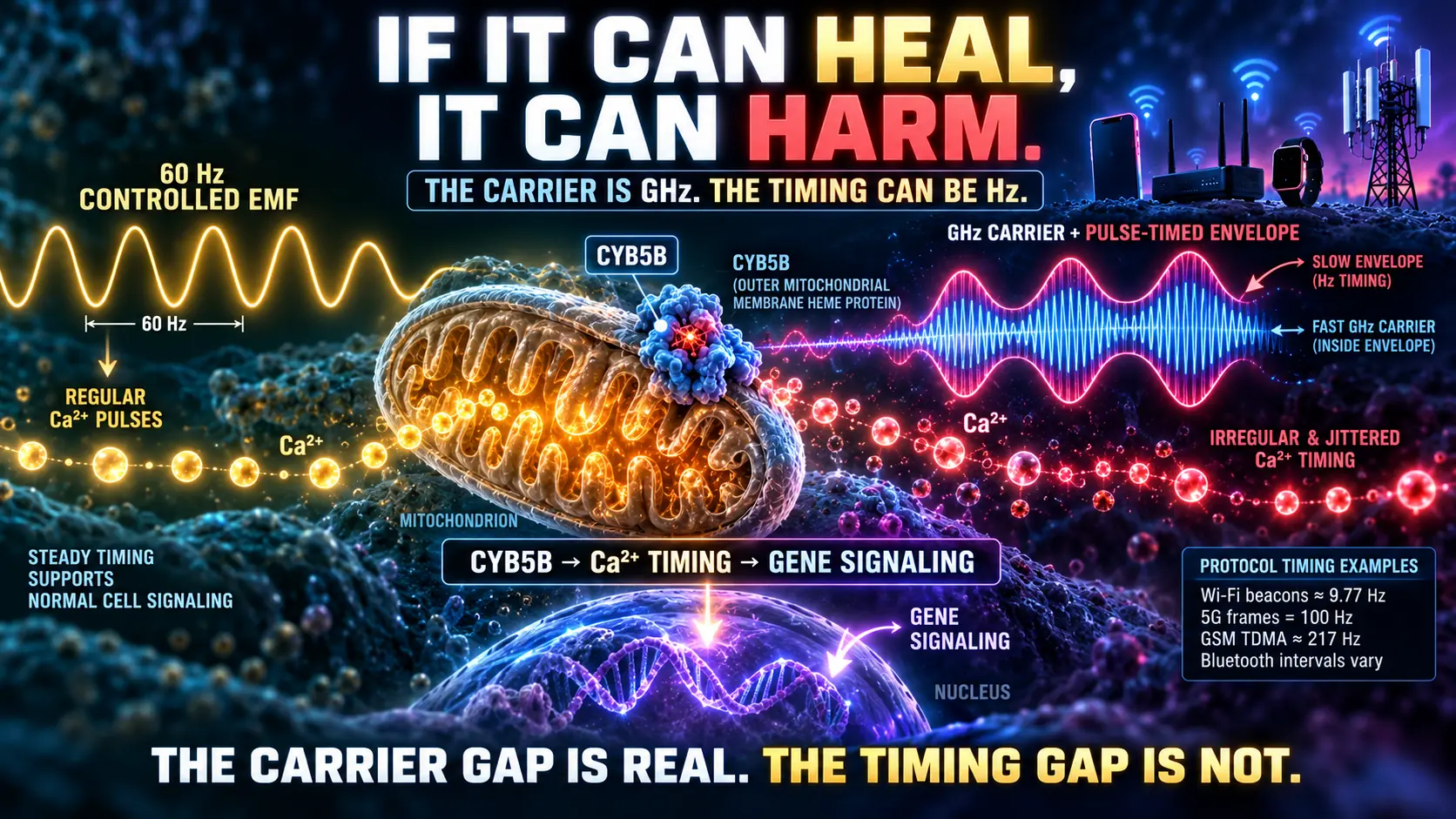
Modern digital radios contain multiple clocks at once. Examples include:
These examples do not make a modulated gigahertz signal physically identical to a standalone 60-hertz magnetic field. That distinction should be stated plainly. But it is equally incorrect to pretend that a GHz carrier contains no biologically relevant low-frequency timing. Nonlinear and rectifying systems can translate an envelope into slower dynamics. Semiconductor radios do it intentionally. Whether particular cellular interfaces can do it under realistic exposure conditions is an empirical question that must be measured.
The experiment federal agencies have not completed
Compare continuous and pulsed signals, matched-carrier and matched-envelope controls, multiple duty cycles, rise times, peak-to-average ratios, and recovery intervals. Record membrane voltage, calcium waveform, mitochondrial redox state, gene expression, and post-exposure recovery. If the outputs differ at equal average SAR, average SAR is not a complete biological metric.
The carrier gap is real. The timing gap is not. A modern standard must characterize both.
RF Safe's S4-Mito-Spin framework integrates the evidence into a falsifiable mechanism map. It explains where an external field can enter biological control, how a small timing perturbation can be amplified, and why repeated errors can produce many downstream outcomes rather than one signature “RF disease.” HHS should test this framework directly instead of continuing to study isolated endpoints without a systems model.
Voltage-gated ion channels contain charged voltage-sensing structures, commonly centered on the S4 helix, that respond to changes in membrane electric potential. These channels regulate calcium, sodium, potassium, and other ionic flows essential to excitability, secretion, development, contraction, and gene regulation.
The established biology is that S4-containing channels are voltage sensors and calcium waveforms carry information. RF Safe's model predicts that particular external fields, envelopes, pulses, and induced membrane perturbations can bias the probability and timing of channel opening under biologically susceptible conditions.
The most informative endpoint is not merely total calcium. It is the full calcium waveform: baseline, amplitude, frequency, pulse width, phase, localization, propagation, termination, and recovery.
Mitochondria convert calcium and substrate signals into ATP production, redox signaling, membrane potential, biosynthesis, stress responses, fusion and fission decisions, and mitophagy. A small timing error at the membrane can therefore be amplified into altered energy allocation or recovery.
CYB5B is especially important because it places a redox-active, heme-containing protein at the mitochondrial outer membrane within reach of calcium signaling, lipid metabolism, electron transfer, and mitochondria-ER communication. The 2026 Cell paper makes CYB5B-dependent field transduction a specific experimental target rather than a vague appeal to “electromagnetic sensitivity.”
Flavins, hemes, iron-sulfur centers, quinones, oxygen radicals, and transient radical pairs participate in mitochondrial and cellular redox chemistry. Spin-selective reactions provide a physical route by which a magnetic field can alter reaction probabilities without first heating bulk tissue.
Spin chemistry supplies a non-thermal physical route by which field conditions can change reaction probabilities. The necessary federal experiments are concrete: measure radical lifetime, singlet-triplet conversion, product yield, redox timing, field strength and orientation, static-field background, molecular geometry, and downstream amplification under realistic waveforms.
S4, mitochondrial, and spin-sensitive pathways converge on one systems-level prediction: repeated, biologically uncoordinated exposure can reduce the precision with which cells sense, decide, act, and recover.
RF Safe calls a persistent mismatch between environmental electromagnetic timing and endogenous biological control bioelectrical dissonance. When recovery becomes incomplete, the organism accumulates recovery debt. The resulting state is low-fidelity biology.
Low-fidelity biology is not a claim that every exposed person develops the same diagnosis. It is a systems hypothesis about biological error control: errors become easier to generate, harder to correct, and more likely to persist. The immediate outcome is not necessarily a named disease. It is a reduction in the reliability of the processes that prevent many diseases.
The upstream causation problem
The conventional one-exposure, one-disease model is poorly matched to a disturbance of membrane signaling, calcium timing, mitochondrial recovery, redox control, repair, and developmental coordination. The causal fingerprint of an upstream fidelity loss is not one diagnosis. It is a shifted distribution of biological failure.
The expected errors are therefore control failures:
This is the meta-disease state predicted by the low-fidelity biology hypothesis: an upstream loss of control-layer precision that raises the probability of many downstream failures. The appropriate causal question is not whether RF is the exclusive cause of one named disease. It is whether exposure contributes to measurable losses in signaling fidelity, repair capacity, and recovery—and whether those losses shift population risk.
The predicted population pattern is not one new disease with one simple signature. It is exactly the pattern RF Safe has warned about for decades: the rare becomes less rare; conditions that once clustered later in life appear earlier; susceptible tissues fail first; and other insults become more consequential because recovery capacity has been reduced.
RF exposure does not need to operate alone to matter. Air pollution, ultra-processed food, poor nutrition, sleep and circadian disruption, infection, chemical toxicants, psychosocial stress, medical interventions, and genetic susceptibility can all burden the same signaling and recovery systems. These co-contributors do not exonerate RF. They explain biological variability and why the same nominal exposure can produce different outcomes in different people.
A healthy system can absorb an insult and return to baseline. A system already carrying oxidative, metabolic, inflammatory, or circadian load has less reserve. In that setting, an additional source of timing error can become the difference between compensation and decompensation. Biology follows its path of least resistance: the vulnerable ion channel, the impaired mitochondrion, the susceptible genotype, the developing neural circuit, or the tissue with the highest energy demand.
The stakes are highest during development because bioelectric signaling does not merely maintain tissue; it helps build it. Membrane-voltage patterns, calcium waves, gap-junction communication, mitochondrial metabolism, redox state, morphogen signaling, and gene-expression timing help determine when cells divide, migrate, differentiate, connect, and stop growing.
An adult system often has redundancy, repair, and an established anatomical template. A developing embryo, fetus, infant, or child is creating that template in real time. A mistimed signal during a critical window may not produce an immediate clinical event. It may alter the trajectory on which later cognition, metabolism, immunity, fertility, or tumor suppression depends.
Development has no restore point. A timing error can be brief while its consequence is lifelong.
For that reason, a public limit based on an adult-sized model and short-term heating cannot be presumed to protect prenatal development or childhood. HHS should treat pregnancy, infancy, childhood, puberty, and germ-cell development as distinct exposure classes and study waveform, timing, cumulative burden, and recovery at each stage.
A strong comment should not merely say “wireless is dangerous” or attach an unorganized list of papers. It should ask HHS for specific actions tied to the questions in the notice and to its statutory authority.
Ask HHS to publish a formal implementation plan for 21 U.S.C. sections 360hh through 360ss, including responsible offices, appropriations needs, milestones, public reporting, research grants, product testing, exposure-minimization work, and interagency coordination.
Ask HHS and NIH to restart long-term RF toxicology after the positive NTP findings. The program should include modern 4G, 5G, Wi-Fi, Bluetooth, DECT, wearable, and mixed-source waveforms; prenatal and juvenile exposure; reproductive and multigenerational endpoints; chronic low-dose conditions; sham controls; blinded pathology; preregistration; independent dosimetry; and open data.
Require experiments that hold average SAR or power density constant while varying modulation, pulse structure, duty cycle, rise time, peak-to-average ratio, beamforming, polarization, and recovery interval. That is how investigators can determine whether average power alone predicts biology.
Ask federal research programs to measure time-resolved cytosolic, ER, and mitochondrial calcium; membrane voltage; mitochondrial membrane potential; ATP/ADP; NADH/FAD redox state; compartment-specific reactive oxygen species; ion-channel activity; gene-expression rhythms; DNA repair; mitochondrial quality control; and post-exposure recovery.
Require CYB5B knockout-and-rescue experiments, voltage-gated-channel perturbations, mitochondrial calcium controls, spin-sensitive controls, and sequencing of events. A proposed mechanism becomes persuasive only when the field-induced molecular event precedes and predicts the downstream biological change.
Children are not small adults. Developing tissues, lifelong cumulative exposure, thinner anatomical barriers in some regions, rapidly changing neural networks, school-day duration, and limited ability to choose their environment justify distinct assessment.
Ask HHS to develop child-specific and pregnancy-specific guidance, exposure metrics, device-use instructions, school infrastructure recommendations, and research priorities. Safety should account for chronic near-body devices, wearables, classrooms, buses, bedrooms, and prenatal exposure—not only a brief compliance test on an adult-sized model.
Ask CDC and other agencies to develop:
Exposure surveillance must record technology and waveform, not merely ask whether someone “used a cellphone.”
Ask for disclosures that describe realistic operating conditions, simultaneous transmitters, antenna locations, body-contact assumptions, adaptive power behavior, peak and average emissions, and practical ways to reduce exposure.
Users should be able to disable individual radios, select wired modes, and understand when a device increases power because of weak reception, obstruction, or a poorly designed accessory. Schools and local governments should receive accessible exposure and infrastructure information rather than being told only that a facility is “compliant.”
The goal is not to ban communication. It is to make high-speed communication possible with substantially less compulsory RF exposure.
Ask HHS to recommend fiber and Ethernet as the fixed backbone, wired connections where mobility is unnecessary, power-over-Ethernet systems where appropriate, and a national mandate for Li-Fi compatibility in devices used in schools, childcare settings, healthcare environments, workplaces, and homes.
Li-Fi will not replace every radio link or solve every exposure problem. It can move large volumes of indoor data onto light-based connections and give families, schools, and institutions a genuine lower-RF choice. Public Law 90-602 expressly contemplates developing and evaluating techniques that minimize unnecessary electronic-product-radiation exposure. Alternatives belong in the health policy, not at the margins of it.
HHS should also state the policy consequence plainly: health-based local decision-making cannot remain constrained by Section 704 of the Telecommunications Act while the underlying federal exposure standard is under unresolved remand and was never derived from lifetime cancer, reproductive, developmental, or bioelectrical risk. Congress should repeal or substantially reform that preemption, restore a meaningful environmental-health role for EPA, and ensure that communities can choose lower-exposure infrastructure.
Ask HHS to publish authorship, funding, conflicts, institutional affiliations, guideline roles, advisory positions, prior public conclusions, protocol deviations, excluded evidence, and dissenting analyses for every federal review. Scientific disagreement should be visible and adjudicated on methods. Current or recent authors of the FCC, ICNIRP, IEEE, or national RF guidelines should not control the chair, voting majority, evidence grading, or final wording of the panel charged with deciding whether those guidelines are protective. HHS should commission independent reanalysis, invite genuinely divergent experts, and release data and code sufficient for public replication.
Research is not a substitute for immediate risk reduction. HHS should advise families, schools, clinicians, and employers to reduce unnecessary near-body and continuous exposure through distance, speaker mode, wired headsets and connections, radios off when not needed, wired classroom infrastructure, and special care during pregnancy and childhood. These are low-cost measures that preserve communication and do not require waiting for a perfect numerical standard.
Ask HHS to file its final evidence assessment and recommendations in FCC ET Docket 13-84, and ask the FCC to explain publicly how it incorporates them. The communications regulator should not be able to say it is waiting for health agencies while the health agencies say exposure limits belong to the FCC.
The most relevant questions for a policy-and-science comment are likely Questions 5, 6, 8 through 13, and 16 through 18. People with personal or clinical experience may also answer Questions 3 and 4 without disclosing private information.
Personalize this text. A specific, sourced comment carries more value than thousands of identical submissions.
Re: HHS-OASH-2026-0397, Request for Information on EMFs, RF Radiation, and Wireless Radiation Exposure
I submit this comment as a [parent / clinician / researcher / educator / worker / engineer / concerned member of the public]. I believe the present FCC radiofrequency limits are inadequate because they were not derived to protect against lifetime cancer, reproductive, developmental, neurological, or bioelectrical effects. Compliance with a thermal-centered limit should not be represented as proof of biological safety. I ask HHS to treat this RFI as the first step toward full implementation of the federal electronic-product-radiation responsibilities established by Public Law 90-602 and now codified at 21 U.S.C. sections 360hh through 360ss.
Questions 5, 6, and 12 — Standards and evidence below current limits: The NTP reported clear evidence of malignant heart schwannomas and some evidence of malignant gliomas in male rats. The Ramazzini Institute independently reported the same rare heart-tumor type at much lower far-field intensity. A WHO-commissioned animal review rated the evidence for malignant glioma and heart schwannoma as high certainty. Melnick and Moskowitz then applied established risk-assessment methods and found the current 0.08-watt-per-kilogram whole-body public limit 15 to 900 times above their cancer risk-based levels and 8 to 24 times above male-reproductive reference levels. HHS should reproduce those calculations, publish sensitivity analyses, and either establish protective benchmarks or rebut the analysis line by line. It should not continue to treat a heating-based compliance limit as a lifetime safety determination.
Questions 5 and 17 — Independence and institutional overlap: HHS should not outsource this assessment to the same small professional network that authored, administers, or repeatedly defends thermal-centered guidelines. The 2024 WHO-commissioned human-cancer review was led by Ken Karipidis, an ICNIRP Main Commission member and current vice chair. A peer-reviewed cross-review analysis reported ICNIRP members Martin Röösli and Karipidis serving on four and three WHO review teams, respectively. The 2026 commentary that downgraded the animal-cancer certainty ratings was written by four German Federal Office for Radiation Protection researchers, three of whom are listed on ICNIRP working-group rosters. Expertise is welcome, but the body evaluating whether a standard is protective must be structurally independent of the body that made or defends that standard. HHS should disclose all guideline roles, advisory appointments, funding, prior positions, exclusions, protocol deviations, dissent, data, and analytic code.
Questions 5(p), 8, and 13 — Real-world exposure and waveform: Exposure classification should include carrier frequency, field amplitude, pulse repetition, pulse width, duty cycle, rise and fall times, peak-to-average ratio, modulation, polarization, beamforming, simultaneous frequencies, distance, near-body operation, cumulative duration, developmental timing, and recovery interval. Studies should compare different waveforms at the same average SAR or power density. Average absorbed power should not be presumed to capture every biologically relevant characteristic.
Questions 11 and 15 — Sensitive populations and infrastructure: HHS should establish separate assessment and guidance for children, pregnancy, workers, people with implanted devices, and people with preexisting conditions. It should evaluate cumulative exposure in homes, schools, childcare facilities, healthcare settings, workplaces, and neighborhoods with dense antenna deployment.
Questions 10, 16, and 17 — Surveillance and federal research: HHS should restore an independent, long-term RF research program with modern waveforms, prenatal and juvenile cohorts, reproductive and multigenerational endpoints, blinded pathology, preregistration, open data, and independent dosimetry. CDC should develop exposure and health surveillance; NIH should fund mechanisms and replication; FDA should evaluate electronic-product-radiation performance, disclosure, and exposure-reduction options under existing law. Human surveillance must measure cumulative call time, near-body use, multiple sources, changing technology, latency, and anatomical location rather than relying on crude “ever versus never” categories.
Question 16 — Bioelectric mechanisms: Federal research should measure time-resolved calcium signaling, membrane voltage, mitochondrial membrane potential, ATP and redox dynamics, reactive oxygen species, gene-expression timing, DNA repair, mitochondrial quality control, and post-exposure recovery. The 2026 Cell study identifying CYB5B-dependent EMF transduction through rhythmic calcium oscillations provides a concrete experimental lead. Voltage-gated S4 sensor pathways, mitochondrial amplification, and spin-sensitive redox chemistry should be tested with knockout, rescue, and pathway-specific controls.
Questions 5(p), 13, and 16 — Therapeutic RF and temporal structure: FDA's authorization of the amplitude-modulated TheraBionic P1 device, the device's calcium-channel contraindication, and related CaV3.2 research demonstrate that carefully selected low-energy RF parameters can produce clinically relevant biological effects without relying on bulk tissue heating. That fact requires parameter-specific safety science. Federal studies should separately characterize the microwave carrier and its low-frequency envelope, framing, burst, beacon, and duty-cycle patterns. A GHz carrier does not eliminate Hz-range temporal structure. Studies should hold average absorbed power constant while changing these timing variables and measuring calcium-waveform fidelity and recovery.
Questions 11, 12, and 16 — Upstream effects and development: HHS should not limit causation analysis to one exposure producing one unique diagnosis. A disturbance of membrane signaling, mitochondrial recovery, redox control, and developmental timing could act upstream of many outcomes. The relevant population signature is a shift in the distribution of failure: rare conditions becoming less rare, later-life failures appearing earlier, and transient disturbances becoming persistent in susceptible people. Prenatal development, infancy, childhood, puberty, and germ-cell development require dedicated cohorts because developmental bioelectric errors can be brief while their consequences are lifelong.
Questions 5(o), 9, and 18 — Exposure reduction and alternatives: HHS should develop and test practical methods to minimize unnecessary exposure, as contemplated by 21 U.S.C. section 360ii. It should issue interim guidance now, including distance, speaker mode, wired connections, radios off when unnecessary, and wired school infrastructure. Long-term recommendations should prioritize fiber and Ethernet for fixed connections, meaningful radio-off controls, transparent consumer disclosure, and a national Li-Fi compatibility requirement for indoor high-data applications, especially in schools and healthcare settings.
I also ask HHS to place its completed assessment and recommendations into FCC ET Docket 13-84 so the FCC's response to the 2021 court remand is informed by a transparent health-agency record. HHS should advise Congress that Section 704 health-based preemption is untenable while the underlying federal standard remains incomplete, and it should support restoration of a meaningful EPA role in RF health protection. Uncertainty should lead to independent research, stronger safeguards, and lower avoidable exposure—not permanent reliance on a 1996 framework.
The FCC proceeding is narrower, so adapt your comment to the remand. Focus on:
File through FCC ECFS and enter 13-84 as the proceeding. The FCC notice states that comments are due 30 days after its Federal Register publication; verify the live deadline before submitting.
HHS did not ask citizens to pretend they have no position. It asked what they know, what they have experienced, what the science means, and what the federal government should do. RF Safe's answer is that the era of treating “below the thermal limit” as synonymous with “safe” must end.
The central issue is larger than whether one model of phone, one frequency, or one disease can be isolated from every other influence.
Modern organisms maintain health through bioelectrical timing: membrane voltage, calcium codes, mitochondrial energetics, redox balance, gene regulation, repair, immune surveillance, and recovery. Our communications environment now overlays those systems with billions of engineered signals that were optimized for data throughput, not biological compatibility.
The public-health question is therefore not limited to whether RF produces enough heat to damage tissue in a short test. It is whether society is degrading the control-layer fidelity on which development, metabolism, cognition, immunity, fertility, repair, and healthy aging depend.
The question is whether chronic, pulsed, modulated, cumulative electromagnetic exposure can reduce the fidelity of biological signaling and recovery—and whether that loss of fidelity makes rare failures less rare and later-life failures arrive earlier.
That question is testable. The tools exist. The positive animal findings exist. The human warning signals exist. The mechanistic transducers exist. The statutory authority exists. Lower-exposure communications alternatives exist. The evidence does not justify another decade of institutional delay.
What has been missing is a coordinated federal decision to investigate the entire problem rather than define most of it out of existence.
HHS has now asked the questions. The FCC has reopened its record. Public Law 90-602 already states the duty. Secretary Kennedy has signed the notice. The public should demand independent review, immediate exposure-reduction guidance, renewed federal toxicology, modern standards, truthful labeling, repeal or reform of Section 704, restoration of environmental-health oversight, and Li-Fi-compatible infrastructure that gives every school and family a lower-RF choice.
This is not a request for HHS to declare every mechanistic detail settled. It is a demand that HHS stop treating unanswered questions as proof of safety. Build the record. Protect children now. Enforce the law. Modernize the standard. Make the evidence impossible to ignore.
These are the working policy and science documents behind this page. Use them to draft an original comment, brief an organization or elected official, or build a more technical filing. Please adapt the language to your own role and experience rather than submitting an unedited duplicate.
A print-ready model statute covering prospective tower setbacks, federal RF review, optical-connectivity pilots, Li-Fi interoperability, photonics grants, and congressional reporting.
Download model statuteA citation-rich comments supplement addressing S4 voltage sensing, TheraBionic P1, CYB5B, calcium timing, mitochondrial redox biology, tissue-specific susceptibility, and Public Law 90-602.
Download science supplementRF Safe's attorney-facing review of scientific and legal vulnerabilities, with proposed remedies for a stronger non-thermal evidence submission.
Download strategy letterAsk HHS to build the independent health record required by Public Law 90-602. Ask the FCC to answer the court's remand with modern science—not another repetition of a thermal-only assumption. Demand child-specific research, waveform-aware standards, truthful disclosure, restored federal oversight, and Li-Fi-compatible infrastructure.