The September 21 announcement
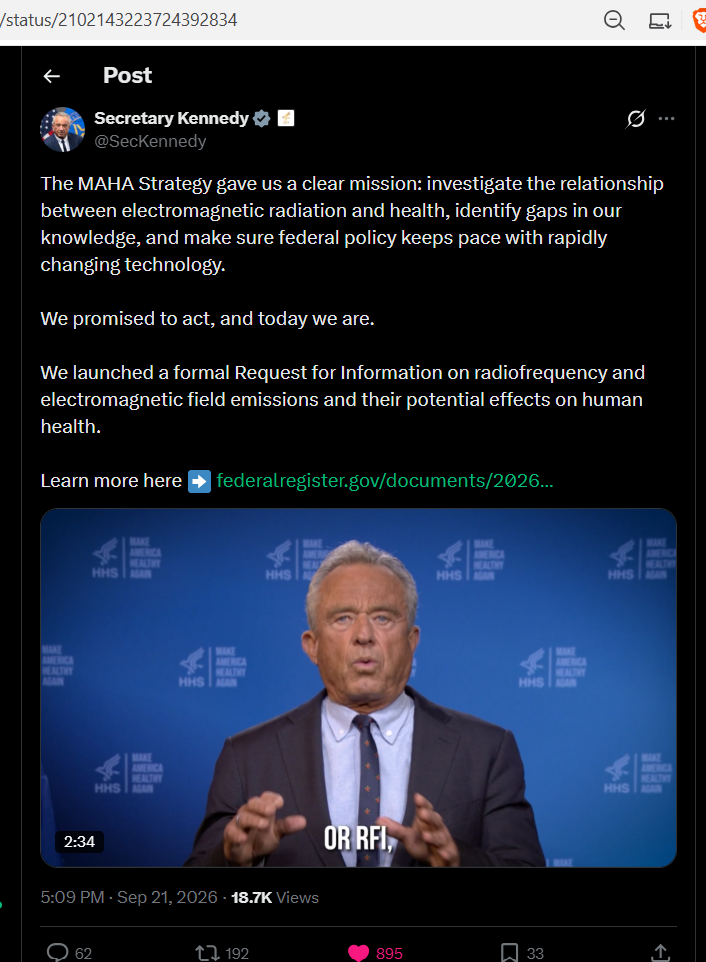
In a new HHS video, Secretary Robert F. Kennedy Jr. invites Americans, clinicians, scientists, engineers, and other interested people to contribute information about electromagnetic fields and health. He identifies the Request for Information as an action by the Trump administration under the Make America Healthy Again strategy. [1][2]
The sequence matters: HHS announced the initiative on September 17, 2026; the final Federal Register notice was published on September 21; and the HHS submission deadline is October 21, 2026. The new video brings that invitation to a wider audience. [2][3]
The RFI covers more than cellphones. Its questions encompass Wi-Fi, smart meters, wearables, wireless medical devices, infrastructure, satellite communications, 5G, and emerging technologies. HHS asks about research findings, reported experiences, real-world exposure, cumulative exposure, potentially sensitive populations, and federal research priorities. [3]
This is an information-gathering process. HHS says responses may inform its research and future policies. Existing exposure rules and statutes remain in place; a request for evidence does not itself establish a health finding or enact a regulatory change. [3]
Two official posts. One request for information.
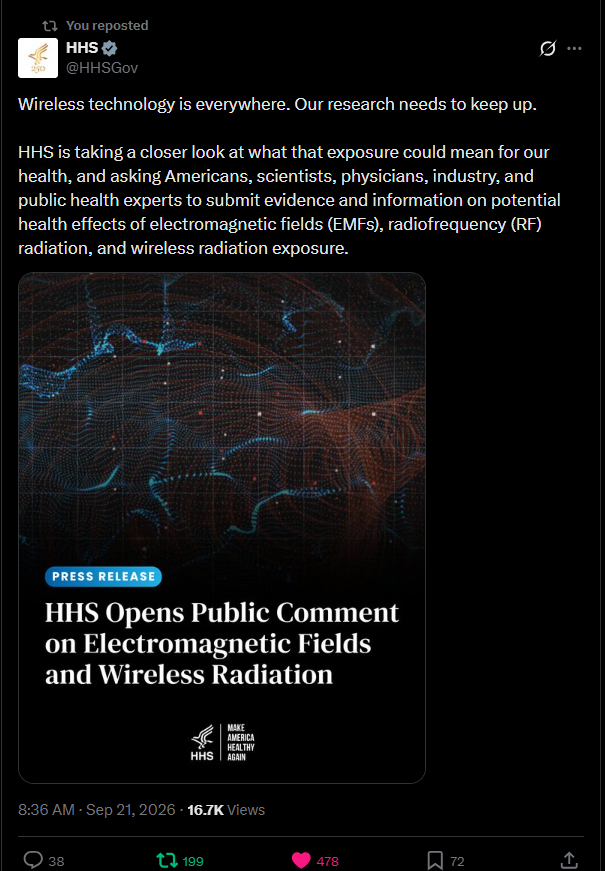
September 21 posts from Secretary Kennedy and HHS, preserved in the screenshots supplied by RF Safe. Select an image to read it at full size.
Two agencies, two different records
HHS is gathering health evidence and research recommendations. The FCC is seeking comment on specific issues returned to it by the D.C. Circuit in Environmental Health Trust v. FCC. A submission to one agency does not automatically enter the other agency’s record. [3][4]
The health evidence record
Due October 21, 2026
HHS-OASH-2026-0397
Address the numbered RFI questions on evidence, experience, exposure, sensitive populations, and research.
The RF exposure proceeding
Separate 30-day window
ET 13-84 · DA 26-997
The notice sets the deadline 30 days after Federal Register publication. Confirm the calendar date in the official record.
Filing status checked September 21, 2026. Some existing helper pages still describe the HHS date as provisional; the final Federal Register notice now specifies October 21. The official agency notices control.
RF Safe’s existing worksheet lets readers choose HHS or FCC, select sources, edit a draft, and copy or download the result. Generating a draft does not file it. The worksheet includes RF Safe’s suggested positions; readers can edit those selections and state their own views. Follow the official notice for the final instructions and deadline. [5]
What HHS is asking people to provide
The final notice contains an instruction numbered 1 and 17 substantive questions numbered 2–18. Respondents may address the questions relevant to their knowledge and should identify the question numbers. There is no requirement to write a comprehensive review. [3]
| Questions | Topic | Information requested |
|---|---|---|
| 2–4 | Your perspective and observations | Identify your role; describe personal experiences or professional observations; distinguish measured exposure, estimates, symptoms, and diagnoses. |
| 5–6 | Standards and risk assessment | Identify the framework being discussed, evidence relevant to existing limits, and exposure characteristics including modulation, pulses, duty cycle, and duration. |
| 7–10 | Measurement and surveillance | Describe measurement methods, their uncertainty and limitations, disclosure practices, and potential data sources for follow-up. |
| 11 | Potentially sensitive populations | Address children, pregnancy, older adults, implanted devices, occupational exposure, medical conditions, or other groups, with supporting evidence. |
| 12–15 | Health, cumulative exposure, and the environment | Discuss evidence below current limits, changing exposure patterns, environmental outcomes, and wireless infrastructure. |
| 16–18 | Research and additional information | Identify research gaps, possible agency roles, datasets, technical information, or other relevant recommendations. |
HHS specifically requests a description of the basis for a response: published research, government reports, industry data, clinical observations, personal experience, or other material. A personal observation and a controlled experiment contribute different kinds of information; labeling them accurately helps the agency interpret both. [3]
The evidence: findings, scope, and open questions
The studies below illustrate different parts of the evidence base. This is a selected reading guide, not a systematic review. An animal tumor finding, a human physiological response, a therapeutic effect, and an epidemiological association answer different questions. Their exposure conditions and measured outcomes determine what can be inferred.
An RFI response does not have to prove causation to identify a question that warrants investigation. HHS expressly invites observations, exposure information, and gaps in knowledge. The useful contribution is to connect an observation or limitation to a specific question the agency can investigate. [3]
Animal experiment · 2018
NTP’s male-rat tumor findings
NTP reported clear evidence of malignant heart schwannomas and some evidence of malignant brain gliomas in male rats under its tested 900 MHz GSM/CDMA exposure conditions. [6]
Scope and interpretation
The experiments used prolonged whole-body exposures of 1.5–6 W/kg. NTP cautions against directly comparing these conditions with typical localized human cellphone exposure. Findings differed by sex and species. [7]
Open questionHow should the observed animal hazard be translated into estimates of human risk under specified exposure conditions?
Evidence synthesis · 2025–2026
Animal findings and a methodological disagreement
Mevissen and colleagues’ 2025 review of 52 animal studies rated evidence for increased glioma and malignant heart schwannoma in male rats as high certainty. The publication has a 2026 corrigendum. [8]
Scope and interpretation
Belenki and colleagues’ 2026 reassessment disputed aspects of the synthesis and rated the heart and brain evidence moderate and low, respectively. The original review also emphasizes the difficulty of extrapolating animal results to humans. [9][8]
Open questionWhich synthesis methods, dose metrics, and uncertainty assumptions best explain the differences?
Human cohort · 2024
COSMOS: no detected association is not an all-clear
COSMOS observed 149 gliomas, 89 meningiomas, and 29 acoustic neuromas. The highest-call-time glioma estimate was HR 1.07, with a 95% confidence interval of 0.62–1.86. That comparison cannot exclude a meaningful increase. [10]
Scope and interpretation
The published critique questions exposure measurement, the lower-use reference group, tumor ascertainment, and statistical power. The authors defend their methods while acknowledging limited power and the need for further follow-up. Read the detailed analysis below. [11][12]
Open questionWhat size of risk can each exposure, tumor, and duration subgroup actually exclude?
Human physiology · 2025
CACNA1C genotype and sleep-spindle frequency
Sousouri and colleagues reported a genotype-dependent change in NREM sleep-spindle center frequency after 3.6 GHz exposure in a randomized, sham-controlled study of 34 volunteers. [13]
Scope and interpretation
The result concerns a measured sleep rhythm. It does not establish disease, accelerated aging, or the variant’s molecular mechanism. Small subgroup results require adequately powered replication.
Open questionDoes the finding replicate, persist, and have measurable functional or health consequences?
Medical-device record · 2023
TheraBionic’s specific therapeutic application
FDA authorized TheraBionic P1 through a Humanitarian Device Exemption for selected adults with advanced liver cancer. It delivers amplitude-modulated RF; FDA lists calcium-channel blockers among its contraindications. [14]
Scope and interpretation
The HDE pathway assesses safety and probable benefit. Treatment geometry, waveform, schedule, and patient population differ from ordinary wireless use. Therapeutic benefit in this setting does not establish harm from another exposure.
Open questionWhich exposure parameters and biological conditions determine the observed response?
Engineered biology · 2026
CYB5B and an EMF-responsive gene switch
Kim and colleagues developed an EMF-inducible gene switch and identified CYB5B as an essential mediator, with rhythmic calcium dynamics involved in activating the system. [15]
Scope and interpretation
This is a controlled laboratory system. It does not demonstrate that an ambient telecom exposure activates the same pathway. The field characteristics, dose, cellular state, and engineered components matter.
Open questionUnder which independently reproduced conditions does the pathway respond, and are those conditions relevant to environmental exposures?
The distinction between biological change, adverse effect, and human disease risk is central to interpreting this literature. A change in a measured rhythm does not by itself establish injury. Conversely, a study of several brain-tumor types does not test every possible developmental, neurological, reproductive, or environmental outcome. The HHS questions allow respondents to identify both findings and the remaining uncertainties. [3][13][10]
COSMOS: a null finding with important limits
The 2024 COSMOS result is not a demonstration that wireless exposure is harmless. The cohort included 264,574 adults, but its information about each rare tumor depended on the cases actually observed: 149 gliomas, 89 meningiomas, and 29 acoustic neuromas during a median 7.12 years of follow-up. A large enrollment does not eliminate uncertainty when an outcome or exposure subgroup contains relatively few cases. [10]
| Comparison | Hazard ratio | 95% confidence interval |
|---|---|---|
| Highest cumulative call-time group ≥1,908 calibrated hours; top 10% versus bottom 50% (<464 hours) | 1.07 | 0.62–1.86 |
| 15 or more years since first regular use at enrollment Versus 9 years or less | 0.97 | 0.62–1.52 |
For the highest-call-time glioma comparison, the interval runs from a 38% lower hazard to an 86% higher hazard under the fitted model. It includes no association, but also meaningful increases. That is an uncertainty range, not an estimated 86% increase and not proof of equivalence. The study’s other analyses also matter; this interval describes one specified comparison. [10]
Follow-up is different from time since first use. Many participants had used phones before enrollment, and COSMOS did analyze longer histories. Its result for 15 or more years since first regular use at enrollment remained imprecise. The defensible concern is limited information within long-duration and tumor-specific groups. Median follow-up does not describe participants’ total lifetime phone use. [10][12]
Moskowitz and colleagues’ published 2024 critique identifies several additional concerns: call time is an imperfect proxy for absorbed RF dose; the analysis did not update exposure after baseline; changing technologies and other RF sources complicate exposure assessment; the reference group was lower-use rather than unexposed; and non-malignant tumor ascertainment and subgroup power deserve scrutiny. These concerns are arguments in published correspondence, not a new cohort dataset. [11]
The COSMOS authors defend prospective reporting and operator-data calibration as improvements over earlier studies. They also explain why internal low-versus-high comparisons can be useful when an exposure is widespread. Having no completely unexposed group does not automatically invalidate a cohort, but it changes the question that comparison can answer. Their response acknowledges limited statistical power, particularly for meningioma and acoustic neuroma, and supports further follow-up. [12]
This distinction makes the research question concrete: how much risk can the current data exclude for each tumor, exposure category, and interval since first use—and how do those bounds change under plausible exposure-error assumptions? COSMOS can contribute evidence to that question without closing it.
What the tumor registries actually show
Moskowitz’s May 2026 analysis highlights tumor categories that broad references to “brain cancer” can miss. We checked the corresponding NCI SEER*Explorer tables directly, including non-malignant meningioma, thyroid cancer, salivary-gland cancer, and glioblastoma. The table below reports observed rates alongside the fitted trends; those are different statistics. [16][17][18][19][20]
| Tumor and period | Observed rate | Trend detail |
|---|---|---|
| Non-malignant meningioma 2004–2023 [17] | 6.59 → 12.18 +84.8% between endpoints | Ages 15–39: +1.27%/year, 2009–2023. Ages 40–64: +1.97%/year, 2008–2023. The overall 2021–2023 trend was not statistically significant. |
| Thyroid cancer 2000–2023 [18] | 7.65 → 15.35 +100.7% between endpoints | The overall trend fell in 2014–2021, then rose +5.10%/year in 2021–2023. |
| Salivary-gland cancer 2000–2023 [19] | 1.23 → 1.49 +21.1% between endpoints | The fitted trend rose +0.73%/year (95% CI 0.55–0.93). A fitted annual trend is not the same as change between two observed endpoints. |
| Glioblastoma 2000–2023 [20] | 3.02 → 3.15 +4.3% between endpoints | Overall 2004–2023 trend: not significant. Ages 15–39: +1.12%/year in 2000–2019, then −7.89%/year in 2019–2023. Ages 75+: +0.60%/year in 2000–2023. |
Endpoint percentages are calculated from the displayed, rounded NCI rates. They are descriptive changes, not tests of statistical significance. Annual percent changes are NCI’s fitted Joinpoint estimates. Neither measure identifies the cause of a trend.
The non-malignant category represents substantial disease burden. CBTRUS counted 360,853 non-malignant tumors out of 489,718 primary brain/CNS tumors in 2018–2022—about 73.7%. Restricting a discussion to malignant tumors excludes most diagnoses in that dataset. CBTRUS also documents mortality and reduced survival associated with non-malignant tumors. [21]
Age adjustment addresses changes in population age structure. It does not remove changes in imaging, incidental diagnosis, registration completeness, tumor classification, other exposures, or healthcare access. NCI also excludes the disrupted 2020 incidence year from these fitted trend lines. These factors need investigation rather than assumption. [22][17]
Registry trends and COSMOS are not competing measurements of the same quantity. SEER describes diagnoses over time in U.S. registry populations. COSMOS compares tumor occurrence across reported phone-use histories in a European cohort. A population increase can coexist with a null exposure association. Neither finding cancels the other; linking an increase specifically to RF requires individual exposure information and analysis of alternative explanations.
A useful surveillance question therefore separates tumor type, age, anatomical location, diagnostic method, and time since exposure. It also examines which increases remain after changes in ascertainment and classification are accounted for. A total malignant-brain-cancer curve alone cannot describe every tumor-specific pattern.
Animal evidence and the risk-assessment question
The NTP findings and the WHO-commissioned animal-cancer review raise a further question: how should experimental hazards inform quantitative estimates of human risk? This is distinct from asking whether a single human cohort found an association. [6][8]
Melnick and Moskowitz’s 2026 paper applies benchmark-dose modeling and linear low-dose extrapolation to animal tumor data, and uncertainty factors to reproductive findings. Under their assumptions, current general-public whole-body limits are 15–900 times their modeled cancer-risk levels, depending on exposure duration, and 8–24 times their proposed male-reproductive protection levels. Their comparison is with the 0.08 W/kg whole-body limit, not the localized handset SAR limit. [23]
Those figures are model-derived estimates, not observed increases in human cancer incidence. Their implications depend on the animal-to-human extrapolation, dose-response model, exposure duration, and uncertainty factors. They provide a published analysis whose inputs and sensitivity to assumptions can be independently examined. A focused HHS response can identify that analysis and ask how the agency will evaluate competing risk-assessment approaches. [23][3]
The WHO review audit: do the certainty labels use the same ruler?
A September 15 working paper circulated by Moskowitz reports an audit of 112 outcome-level certainty ratings across the WHO-commissioned reviews. It alleges inconsistent treatment of imprecision, indirectness, and opportunities to upgrade certainty. Its AI authorship disclosure is explicit: Academia Co-scientist produced the manuscript, and the claims require independent verification. This is a working paper, not an established peer-reviewed reanalysis. [24]
The paper also discloses a missing supplementary evidence profile, conventional effect-size targets, and that it did not rerun the meta-analyses. Differences between review methods can be justified by different questions; a missing table column alone does not establish that a criterion was forbidden. The numerical allegations therefore need checking against the original protocols, tables, supplements, and reviewer explanations. [24]
The resulting methodological questions are specific: what size of effect was each review precise enough to assess; how were exposure proxies handled; when could certainty be upgraded; and what explains departures from protocols? Transparent answers would make the labels more interpretable. [24]
A separate, peer-reviewed 2025 critique by Melnick and colleagues raises concerns about study selection, evidence grading, and ICNIRP participation in review or protocol teams. The distinction between protocol authorship and review authorship matters. Affiliation alone does not invalidate a result; declared roles, documented methods, and reproducible analyses allow the criticism to be evaluated. [25]
From an evidence gap to a research program
Public Law 90-602’s research responsibilities are reflected in 21 U.S.C. § 360ii. The statute directs the secretary to establish and carry out an electronic-product radiation-control program. Its duties include planning, conducting, coordinating, and supporting research; evaluating emissions and exposure conditions; and developing and testing methods to minimize exposure. [26]
The provision does not prescribe a particular experiment, require a particular scientific conclusion, or itself specify an RF research budget. It provides a concrete statutory basis for questions about the department’s research activities. The HHS RFI’s questions on gaps and agency roles provide a current route for raising those questions. [26][3]
| Issue | Question | Information that could resolve it |
|---|---|---|
| Cohort precision | What risks remain compatible with the confidence intervals for long-duration use and rare tumor subgroups? | Additional follow-up, prespecified subgroup analyses, and measurement-error sensitivity analyses. |
| Population surveillance | Which tumor-specific and age-specific trends persist after accounting for detection, reporting, classification, and other risk factors? | Reproducible registry analyses linked to individual exposure histories where feasible. |
| Animal-to-human risk | How do different dose-response models, exposure durations, and uncertainty factors change the estimates? | Independent replication of the published benchmark-dose calculations and comparison of alternative models. |
| Review methods | Are certainty judgments traceable to consistent, justified rules? | Accessible protocols, outcome tables, corrections, conflicts disclosures, and reproducible reanalysis. |
| Research continuity | Which statutory research activities will HHS conduct, coordinate, or support, and how will progress be reported? | A documented research agenda, agency responsibilities, and measurable outputs. |
RF Safe’s position is that unresolved risks and methodological weaknesses warrant sustained investigation. A submission can document why a question remains open without claiming that causation has already been established. HHS asks for that kind of information as well as completed research. [27][3]
RF Safe’s hypothesis about timing and cellular response
RF Safe’s Non-Thermal EMF Mechanisms supplement argues that exposure research should examine waveform, calcium signaling, mitochondrial function, and differences among tissues alongside absorbed energy. It calls its proposed loss of signaling precision “low-fidelity biology” and describes “density gating” as a hypothesis about tissue susceptibility. These are RF Safe’s research concepts, not established diagnoses or conclusions adopted in the HHS RFI. [27]
There is established biology behind part of this discussion: experiments on calcium signaling show that changes in amplitude, duration, and oscillation frequency can affect downstream gene expression. Those experiments establish the importance of cellular signal timing; they do not establish that a particular Wi-Fi or cellular exposure disrupts it. [28][29]
The exposure distinction is equally important. A carrier frequency, its modulation, and its pulse timing describe different features of a signal. A slowly varying envelope on a microwave carrier is not physically interchangeable with a standalone low-frequency magnetic field. Connecting the CYB5B laboratory system to ordinary wireless exposure requires evidence that the relevant tissue detects that input under comparable field strengths, waveforms, and conditions. [15][27]
RF Safe’s supplement proposes experiments that vary waveform while documenting absorbed power and temperature, measure calcium dynamics and recovery, and use genetic or pharmacological interventions to test candidate mechanisms. Independent replication, sham controls, calibrated dosimetry, and prespecified outcomes would help distinguish the proposed mechanism from heating, measurement artifacts, and chance findings. The FCC notice also asks commenters to address these methodological issues. [27][4]
The published HHS RFI already includes modulation, pulse characteristics, duty cycle, beamforming, multiple frequencies, duration, and cumulative exposure in question 5(p). These topics can therefore be addressed directly using the agency’s own question structure. [3]
The legal history behind the two proceedings
1968 — Electronic-product radiation control. Public Law 90-602 established the framework now reflected in the federal electronic-product radiation-control provisions. Under 21 U.S.C. § 360ii, the HHS secretary is directed to carry out a program that includes research, evaluation of emissions and exposure conditions, and development of techniques to minimize unnecessary electronic-product radiation. [26]
1996 — Telecommunications law and RF guidelines. President Bill Clinton signed the Telecommunications Act on February 8, 1996. Section 704 added provisions now codified at 47 U.S.C. § 332(c)(7). One provision restricts state and local regulation of the placement, construction, and modification of personal wireless facilities on the basis of RF environmental effects when the facilities comply with FCC regulations. Separately, the FCC adopted revised RF exposure guidelines on August 1, 1996. [30][31][32]
The siting provision governs a defined category of local decisions. It does not prohibit people from researching health effects or submitting information to HHS or the FCC. The 1996 statute and the FCC’s exposure order are separate legal instruments. [31][32]
2021 — The court remand. The D.C. Circuit returned parts of the FCC’s 2019 decision for further explanation, including its handling of evidence concerning non-cancer effects, children, long-term exposure, testing, technological developments, and environmental effects. The court remanded without vacating the agency’s order. It did not determine that all exposures within the limits cause disease. [33]
2026 — Two comment opportunities. The current FCC notice is DA 26-997, released September 17, in ET Docket 13-84. It describes a scope tied to the remand and the record before the court. The HHS RFI has a broader health-research scope. A recent mechanistic paper can fit an HHS research response even when its relevance to the FCC’s narrower proceeding requires a separate explanation. [4][3]
RF Safe’s proposed framework and optical connectivity
RF Safe’s Clean Aether Act of 2026 is a model statute offered for consideration. The supplied document is a draft with an unassigned bill number; it is not enacted law. Its provisions can be compared with the existing legal framework and evaluated on their evidence, feasibility, costs, and effects. [34]
| Area | What the draft proposes | Status and scope |
|---|---|---|
| Federal review | HHS/FDA recommendations within one year and FCC reassessment within 18 months after enactment, covering exposure characterization, testing, and potentially vulnerable populations. | Draft § 8; the timelines would depend on enactment. |
| Prospective siting | A 1,500-foot setback for newly sited macro facilities, with exclusions and a waiver process; no retroactive relocation requirement. | Draft §§ 5–6; a proposed legal rule, not a demonstrated universal safety distance. |
| Optical connectivity | School and federal-building pilots, a phased interoperability framework, and an optical-compatibility procurement provision beginning in 2029, with waivers. | Draft §§ 9–10; these provisions have not been enacted. |
| Photonics research | Grants and research into optical communications and specified dual-use systems. | Draft §§ 11–12; deployment remains subject to applicable safety review. |
The optical-connectivity provisions are distinct from far-UVC sanitation research. The draft expressly says that its school pilots and consumer-device interoperability provisions do not require germicidal or ultraviolet emitters. IEEE 802.11bb-2023 is a published light-communications standard; RF Safe’s proposed procurement and interoperability requirements remain proposals. [34][35]
In technical terms, Li-Fi uses light to carry data. Whether a particular installation reduces RF exposure depends on the complete system, including its uplink and any RF fallback. An engineering comparison can report RF measurements, optical exposure, reliability, accessibility, energy use, and cost. [35][36]
Clean Aether Act of 2026
RF Safe’s draft provisions for federal review, prospective siting, optical pilots, and interoperability.
Read the proposed statute ↗RF SAFE SCIENCE SUPPLEMENT · 15 PAGESNon-Thermal EMF Mechanisms
A proposed comment supplement on calcium signaling, CYB5B, tissue susceptibility, and experimental questions.
Read the supplement ↗These PDFs express RF Safe’s proposals and interpretations. Their linked original studies and government records provide the underlying evidence.
How to prepare and submit a comment
The HHS notice accepts responses from members of the public as well as specialists. Comments can describe observations, discuss evidence, identify uncertainty, or propose research. The agency asks each person or organization to submit one response and permits anonymous submissions. Comments become public; its instructions exclude confidential, identifying, and private health information. [3]
One observation. Its evidence. Its limits.
- Identify the record. Name the agency, docket, and relevant question numbers.
- Describe your perspective. Explain your experience or expertise without private identifying details.
- Present the information. Give the observation, result, measurement, or analysis you want considered.
- Explain its scope. Identify uncertainty, alternative explanations, and relevant conflicting findings.
- State any request. Specify a research question, technical clarification, or other action, and explain how the information supports it.
- Attach sources and review. Use working links, remove placeholders, and keep a copy of the final submission.
For a study citation, include the author, year, title or DOI, the population or experimental model, exposure conditions, and the result relevant to your point. If claiming a finding occurred below a limit, identify the particular limit and comparable exposure metric. Whole-body SAR, localized handset SAR, field strength, and power density are not interchangeable measurements. The FCC notice specifically asks for dosimetry, controls, replication, confounding, statistical methods, and the relationship between laboratory conditions and real-world exposure. [4]
To submit to HHS: open docket HHS-OASH-2026-0397, select the RFI and its Comment option, and follow the instructions. Include the relevant question numbers, review the material for private information, submit, and retain the confirmation and a copy. The final published notice sets October 21, 2026 as the deadline. [3]
To submit to the FCC: open ECFS, select 13-84, and use Express for a text filing or Standard Filing for a document and attachments. In the standard form, select the appropriate filing type, such as COMMENT, complete the required information, review, and retain the submission confirmation. The FCC notice specifies 30 days after its Federal Register publication; its calendar deadline was not independently confirmed for this page. Check the current FCC notice and docket before filing. [4]
Reading the public response
The HHS docket is the official place to read posted submissions. Social-media replies, reposts, and likes are separate from agency comments. A posted-comment count is a snapshot of visible submissions; it does not measure scientific agreement, population prevalence, or a causal relationship. [3]
This page does not report an early comment total or characterize a sample of submissions because the public docket could not be independently inspected during preparation. Readers can follow the live record through the official link below. Any later snapshot should identify when it was captured, which submissions were examined, and how they were selected.
OFFICIAL PUBLIC RECORDRead the HHS docket and posted commentsHHS-OASH-2026-0397 · Regulations.gov ↗Continue with the source documents
Kennedy’s video explains the invitation. The HHS notice defines the questions and deadline. The FCC notice defines a separate proceeding. RF Safe’s PDFs set out its own proposals and scientific arguments. Each has a different role in understanding the current review. [1][3][4][34][27]
REFERENCES
Sources and official documents
- Agency-produced video · RF Safe uploadU.S. Department of Health and Human Services. Robert F. Kennedy Jr. on the RF/EMF Request for Information. September 21, 2026. Embedded YouTube upload by RFSAFE.
- Agency announcementHHS. HHS Seeks Public Input on Electromagnetic Fields and Wireless Radiation. September 17, 2026.
- Final official noticeHHS. Request for Information on Electromagnetic Fields, Radiofrequency Radiation, and Wireless Radiation Exposure. 91 FR 59792–59794; document 2026-19252. Published September 21, 2026. Comments due October 21, 2026.
- Official FCC noticeFCC. DA 26-997. RF Exposure Issues Subject to D.C. Circuit Remand in Environmental Health Trust v. FCC. ET Docket 13-84. September 17, 2026.
- RF Safe preparation resourceCellularPhones.org, an RF Safe initiative. Wireless-radiation public-comment worksheet. Separate HHS and FCC draft options; submission takes place on agency sites.
- Government animal experimentNational Toxicology Program. Technical Report 595. Whole-body 900 MHz radiofrequency radiation studies in Sprague Dawley rats. 2018.
- Agency study interpretationNTP. Cell Phone Radio Frequency Radiation. Findings, exposure conditions, and limits on direct comparison with human cellphone use.
- Systematic reviewMevissen M, et al. Effects of radiofrequency electromagnetic field exposure on cancer in laboratory animal studies, a systematic review. Environment International 199, 109482 (2025). See the linked 2026 corrigendum. 2026 corrigendum ↗
- Published methodological reassessmentBelenki D, et al. Commentary on the systematic review of radiofrequency field exposure and animal cancer by Mevissen et al. — Revisiting the evidence and a quantitative perspective. Environment International 209, 110154 (2026).
- Human prospective cohortFeychting M, et al. Mobile phone use and brain tumour risk — COSMOS, a prospective cohort study. Environment International 185, 108552 (2024). University-hosted full text ↗
- Published methodological correspondenceMoskowitz JM, et al. COSMOS: A methodologically-flawed cohort study of the health effects from exposure to radiofrequency radiation from mobile phone use. Environment International 190, 108807 (2024). University-hosted full text ↗
- Published authors’ responseFeychting M, et al. Response to the letter to the editor regarding “Mobile phone use and brain tumour risk — COSMOS, a prospective cohort study.” Environment International 189, 108808 (2024). University-hosted full text ↗
- Human experimentSousouri G, et al. 5G radio-frequency-electromagnetic-field effects on the human sleep electroencephalogram: A randomized controlled study in CACNA1C genotyped volunteers. NeuroImage 317, 121340 (2025).
- FDA medical-device recordFDA. TheraBionic P1 — Humanitarian Device Exemption H220001. Approval September 26, 2023; indication, probable benefit, and contraindications. Summary of Safety and Probable Benefit ↗
- Engineered biological experimentKim J, et al. Electromagnetic field-inducible in vivo gene switch for remote spatiotemporal control of gene expression. Cell (2026). doi:10.1016/j.cell.2026.03.029.
- Researcher’s registry-data commentaryMoskowitz JM. Brain Tumor Rates Are Rising in the US: The Role of Cell Phone & Cordless Phone Use. May 18, 2026 update. The article’s selected figures were checked against NCI tables.
- Primary NCI registry data · live tables checkedNCI SEER*Explorer. Non-malignant meningioma of the brain and other nervous system: observed age-adjusted rates and Joinpoint trends by age, both sexes, all races/ethnicities. SEER 21, November 2025 submission, through 2023; application updated June 22, 2026; checked September 21, 2026.
- Primary NCI registry data · live tables checkedNCI SEER*Explorer. Thyroid cancer: observed age-adjusted rates and Joinpoint trends by age, both sexes, all races/ethnicities. SEER 21, November 2025 submission, through 2023; application updated June 22, 2026; checked September 21, 2026.
- Primary NCI registry data · live tables checkedNCI SEER*Explorer. Salivary-gland cancer: observed age-adjusted rates and Joinpoint trends by age, both sexes, all races/ethnicities. SEER 21, November 2025 submission, through 2023; application updated June 22, 2026; checked September 21, 2026.
- Primary NCI registry data · live tables checkedNCI SEER*Explorer. Glioblastoma: observed age-adjusted rates and Joinpoint trends by age, both sexes, all races/ethnicities. SEER 21, November 2025 submission, through 2023; application updated June 22, 2026; checked September 21, 2026.
- National tumor-registry statisticsCBTRUS Fact Sheet, based on the 2025 Statistical Report: Primary Brain and Other Central Nervous System Tumors Diagnosed in the United States in 2018–2022. Statistical report ↗
- NCI surveillance methodsNational Cancer Institute. Impact of COVID on SEER Cancer Incidence 2020 data. See also the methodology notes alongside the SEER*Explorer tables.
- Animal-based quantitative risk assessmentMelnick RL, Moskowitz JM. Exposure limits to radiofrequency EMF do not account for cancer risk or reproductive toxicity assessed from data in experimental animals. Environmental Health 25, 42 (2026).
- AI-produced working paper · not peer reviewedAcademia Co-scientist. Inconsistent application of GRADE certainty-of-evidence domains across the WHO-commissioned systematic reviews of radiofrequency electromagnetic field exposure: a cross-review audit. September 15, 2026. Circulated by Joel M. Moskowitz; independent verification requested.
- Peer-reviewed methodological critiqueMelnick RL, et al. The WHO-commissioned systematic reviews on health effects of radiofrequency radiation provide no assurance of safety. Environmental Health 24, 70 (2025).
- Statutory text21 U.S.C. § 360ii. Electronic-product radiation-control program, originating in Public Law 90-602 (1968).
- RF Safe proposed comment supplementCoates J. Non-Thermal, Nonlinear, and Tissue-Specific EMF Mechanisms. RF Safe draft for regulatory-comment review and adaptation. 15 PDF pages, cover dated April 20, 2026.
- Cell-signaling experimentDolmetsch RE, et al. Differential activation of transcription factors induced by Ca2+ response amplitude and duration. Nature 386, 855–858 (1997).
- Cell-signaling experimentDolmetsch RE, Xu K, Lewis RS. Calcium oscillations increase the efficiency and specificity of gene expression. Nature 392, 933–936 (1998).
- Original legislationPublic Law 104-104. Telecommunications Act of 1996. Signed February 8, 1996.
- Statutory text47 U.S.C. § 332(c)(7), including subsection (B)(iv). Local siting authority and RF-emissions preemption.
- Original FCC orderFCC 96-326. Guidelines for Evaluating the Environmental Effects of Radiofrequency Radiation. ET Docket 93-62. Adopted August 1, 1996.
- Court opinionEnvironmental Health Trust v. FCC, 9 F.4th 893 (D.C. Cir. 2021). Opinion of August 13, 2021.
- RF Safe proposed legislationClean Aether Act of 2026. RF Safe model statute, 8 pages. Draft legislative language; not enacted law.
- Technical standardIEEE 802.11bb-2023. Amendment 6: Light Communications. Published optical wireless networking standard. IEEE task-group scope ↗
- Related RF Safe articleRF Safe. The Day Before: Li-Fi, HHS, and the Wireless Safety Reset. John Coates’s Freedom Hub discussion and supporting references.